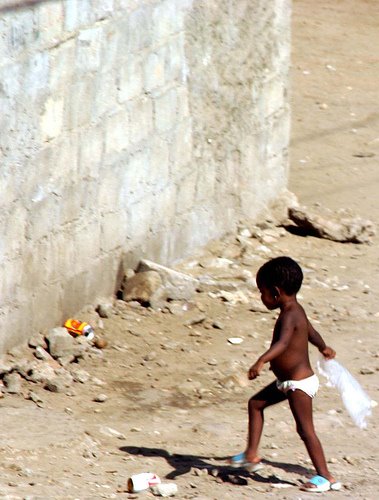
Singapore Authorities Cast a Wary Eye on Civil Groups Ahead of APEC summit
Singapore, the scourge of human rights activists has done it again. The oppresive state hosts the coming Asia-Pacific Economic Cooperation which Obama is attending. Again, the authorities have taken measures to clamp down on civil groups and activists like what they did when they hosted the IMF / WB three years ago.
Even the Pittsburgh Citizen Police Review Board is reviewing the actions of policement during the G20 meetings. It is time for the Singapore government to stop supressing our voices. Then again, perhaps human rights is mostly dead in the Asia-Pacific region.
$$$$$$$$$$$$$$$$$$$$$$
With two weeks to go before heads of state gather for the Asia-Pacific Economic Cooperation (APEC) summit here, Singapore is wary about allowing the entry of well-organised civil groups and disruptive individuals bent on derailing the talks or championing their causes.
Two Falungong followers, a Malaysian and an Indonesian, were reportedly denied entry into Singapore at Changi Airport last week.
According to the Epoch Times, the sect's publication, the pair tried to enter the country separately on Oct 19 and Oct 22. The report also said the pair had previously made frequent trips to Singapore.
Falungong, a religious sect, was banned in China in 1999 after it was accused of fanning social unrest. Though it is not outlawed in Singapore, several of its followers here have been arrested for holding illegal assemblies.
When MediaCorp cited the Falungong example and asked if Singapore was keeping out individuals who might pose law-and-order problems, a spokeswoman from the APEC Singapore 2009 organising committee said all requests to enter the country would be treated fairly.
"All sovereign nations have the prerogative to decide who cross their borders. Singapore is no exception," she said. "This is especially so in the current security climate, where we have a duty to ensure the safety and security of the public."
Security analyst Dr John Harrison from the S. Rajaratnam School of International Studies was not surprised with the entry ban related to APEC.
"The (Singapore) Government will get a variety of information in from all sources - open and classified - from partners in the region and around the world," he said. "It will try and mitigate threats and risks as early as possible."
Apart from the task of keeping out people with backgrounds tied to terrorism, the authorities would have their eye on individuals who could use the event to carry out violent protests, Dr Harrison said.
Three years ago, when Singapore hosted the International Monetary Fund-World Bank meeting, the authorities objected to 28 foreigners - all of whom had a history of taking part in violent protests or disruptive activities at previous meetings - from being allowed into the country.
Then, civil society organisations were allowed to protest in a small corner of the meeting venue at Suntec Singapore International Convention and Exhibition Centre; large-scale protests were confined to the Indonesian island of Batam.
Observers say that unlike the IMF event to which many civil society groups were invited, APEC's broader platform is not likely to warrant the same level of involvement and, hence, numbers of activists.
Labels: Asia-Pacific Economic Cooperation, Batam, Civil Groups, Protest, Singapore
Call for Action: Protest against NATO! Edinburgh, 13 November
If anyone of you are in UK or Scotland this November, drop by Edinburgh on the 13th as friends from all over the world crash NATO's party.
In November the NATO Parliamentary Assembly will meet in Edinburgh. The NATO Parliamentary Assembly is an attempt at legitimising the alliance with
a hint of democracy. This is a front.
The NATO PA does nothing but maintain NATO's role as a global military force used by the west to dominate and control. Its influence stretches from the highlands of Scotland where nature reserves are used as playgrounds for NATO's war games, to the highlands of Afghanistan where villages live in fear of NATO attack.
The movement against NATO is growing across Europe and the world. In April thousands took to the streets of Strasbourg to protest against the NATO summit. In June Scandinavian activists disrupted a NATO training exercise in Sweden. In NATO occupied Afghanistan the Revolutionary Women Of Afghanistan have continued to speak out against NATO's collusion with patriarchal forces still ruining lives in their country.
Now the UK anti-militarist movement sets its sights on Edinburgh for the NATO Parliamentary Assembly. Its time for a show of strength.
We need to show NATO that their militarism is neither wanted or tolerated.
This is an invite for anti-militarists everywhere. Come to Edinburgh and help us resist NATO and militarism. The NATO Welcoming Committee is calling for a mass demo on Friday the 13th of November, the first day of the Parliamentary Assembly. Details of the demo will be released closer to the time. Bring warm clothes, noise, banners and whatever else you hope to find. If you live out of town, aim to be in Edinburgh the day before. Accommodation will be available from Wednesday the 11th of November.
The NATO Welcoming Committee will provide a convergence space for activists to converge and stay in throughout the Assembly, as well as providing food, medical services in terms of street medics and a well-stocked medics space, legal support through the Scottish Activist Legal Project, trauma support and other forms of support to activists.
The NATO Welcoming Committee has signed up to the AMN’s principles.
These are:
We embrace a diversity of tactics
We will not publicly condemn other peoples actions
We have a respect for life
See you on the streets!
The NATO Welcoming Committee
http://natowc.noflag.org.uknatowc [at]
noflag.org.ukLabels: Call for Action, Edinburgh, NATO, Protest
A G20 Meeting for Naught

Police. Resources wasted to facilitate the sham of a meeting
$$$$$$$$$$$$$$$$$$$$$$$$The G20 summit meeting in London from April 1st onward was loudly announced and publicized. Those 20 industrialized and emergent countries (G20) are meeting to find solutions to the crisis. But long before the end of the summit, it is clear that they will not rise to the challenge.
The G20 was not created in order to provide genuine solutions; it was hastily summoned a first time in November 2008 to salvage the powers that be and try and to plug the breaches in capitalism. It is therefore impossible for this body to opt for measures that are sufficiently radical to save the day.
Public opinion will be told to look in the two directions that are expected to focus aggravation: tax havens and the CEOs’ incomes.
Tax havens have to be abolished, that goes without saying. To achieve this it should be easy enough to make it illegal for companies and residents to have any assets in, or relationships with partners located in, tax havens. The EU countries that function like tax havens (Austria, Belgium, the UK, Luxembourg…) as well as Switzerland must do away with bank secrecy and put an end to their outrageous practices. Yet such is not at all the orientation chosen by the G20: a couple of emblematic cases will be cracked down on, minimal measures will be required from those countries, and a black list of non-cooperative territories eventually made public will have been carefully vetted (the City, Luxembourg or Austria have already been promised they will not be on it).
On the other hand CEOs’ incomes, including golden parachutes and other bonuses, are indeed outrageous. In time of growth the employers claimed that those who brought in such benefits to their companies had to be rewarded to prevent them from moving to another. Now that we live in a time of crisis and those companies have to admit to increasing losses, the same executives still claim similar rewards. The G20 will try to regulate their incomes for a limited duration. The logic of the system is not questioned.
Apart from tax havens and CEOs’ superbonuses, which will not be hit by any specific penalties anyway, the G20 countries will further bail out their banks. Though globally discredited and de-legitimized, the IMF will be put back at the hub of the political and economic game thanks to a new provision of funds which will have been made available by 2010.
The G20 strategy is to put a fresh coat of paint on a world which is collapsing. Only a strong popular mobilization will make it possible to lay solid foundations to build another world in which finance is at the service of people, and not the other way round. The 28 and 30 March demos were big ones: 40,000 people in London, thousands and thousands in Vienna, Berlin, Stuttgart, Madrid, Brasilia, Rome, etc. with the common motto “Let the rich pay the crisis!” The week of global action called for by the social movements from all over the world at the WSF at Belém last January thus had a gigantic echo. Those who had announced the end of the movement for another globalization were wrong. It has proved that it is able to bring large crowds together, and this is only the beginning. The success of the mobilizations in France on 29 January and 19 March (three million demonstrators were in the streets) is evidence that the workers, the unemployed and young people all want other solutions to the crisis than those which consist in bailing out bankers and imposing restrictions on the lower classes.
As a counterpoint to the G20 summit, the president of the UN General Assembly, Miguel d'Escoto, has called a general meeting of Heads of States and Governments in June and asked the economist Joseph Stiglitz to chair a commission that will draft proposals to meet the global crisis. The suggested solutions are inadequate because too timid, but they will at least be discussed at the the UN general Assembly.
A new debt crisis is looming in the South, it is a consequence of the real estate private debt bubble bursting in the North. The recession that now affects the real economy of all countries in the North has led to prices of raw material plummeting, which considerably has reduced the strong currency revenues with which governments of countries of the South repay their external public debts. Moreover the current credit crunch has induced a rise in borrowing rates for countries of the South. The combination of these two factors has already resulted in suspensions in debt repayment by those governments that are most exposed to the crisis (starting with Ecuador). Others will follow suit within one or two years.
The situation is absurd: countries of the South are net creditors to the North, starting with the US whose external debt is over US$ 6,000 billion (twice the total external debt of all the countries of the South). Central banks in countries of the South buy US Treasury bonds instead of setting up a democratic bank of the South to finance human development projects. They should leave the World Bank and the IMF, which are tools of domination, and develop South-South relations of solidarity such as those which exist between countries that are members of ALBA (Venezuela, Cuba, Bolivia, Nicaragua, Honduras, and Dominica). They ought to audit the debts they are asked to repay and put an end to the payment of illegitimate debts.
The G20 will see to it that the core of neoliberal logic is left untouched. Its principles are asserted again and again, even though they have blatantly failed: the G20 maintains its attachment to a global economy based on an open market. Its support to the god of free market is non-negotiable. Everything else is hocus-pocus.
Eric Toussaint, PhD in political sciences, is president of the Committee for the Abolition of Third World Debt – Belgium www.cadtm.org ), author of A diagnosis of emerging global crisis and alternatives, Mumbai, India, Vikas Adhyayan Kendra, 2009, 139p.; The World Bank: A Critical Primer, London, UK, Pluto Press, 2008
Damien Millet, a mathematician, is spokeperson for CADTM France (Committee for the Abolition of Third World Debt,).
Joint authors of 60 Questions 60 Answers on the Debt, the IMF and the World Bank, English version to be published in 2009.
Labels: CADTM, Damien Millet, Eric Toussaint, G20, Police, Protest
London: We Wldn't Pay For Their Crisis!

Furious protesters took to the streets, voicing out a shared international displeasure at the bankers who have failed thoroughly. "WE WON'T PAY FOR THEIR CRISIS!!"
$$$$$$$$$$$$$$$$$$$$$$
Tens of thousands marched for five hours in "one of the largest" protests in London on Saturday, four days before the G20 summit kicks off.
Leaders from the world's 20 biggest economies are scheduled to meet in London on April 2 to discuss how tighter regulation of financial markets, billions of dollars in stimulus measures and credit lines for international trade can help the world economy recover.
The police, who are coordinating a large-scale security operation in the build-up to the summit, have been barred from going on leave until the summit ends.
"It's fair to say that this {protest} is one of the largest, one of the most challenging and one of the most complicated operations we have delivered," Commander Simon O'Brien, one of the officers in charge of security, said of Saturday's protest.
While the protest from Temple Place to Hyde Park highlighted several issues, including social inequality, loss of jobs, war and climate change, most took to the street to express their anger over bankers whose greed they say led to the global financial crisis.
The protesters, ranging from union members, taxi drivers and the retired, marched the 7.2-km stretch to the sound of brass bands, piercing whistles and blasting music from stereos. Among them was 73-year-old Geoff Stratford who awoke at 4:30 am so he could arrive in London from Manchester in time for the rally.
"The cause (of the financial crisis) lies in casino capitalism and in the greed of bankers," Stratford told China Daily as he and his wife marched, holding aloft a banner.
"We want to get the view through to the leaders who are meeting to find consensus. We have pensions and are not affected much by the crisis but the leaders should correct their mistakes and make people suffer less," he said and added that he would join the marches scheduled for Wednesday and Thursday as well.
Essex resident Milton McKenzie said: "How can we have a situation where we have people out of work and the bankers just cream it off, helped by the government?"
Dressed in green sportswear, Andrea Porteous and her 10-year-old daughter Taylera raised chants of: "Put children first".
Unwilling to admit she had lost her job, the 40-something former office administrator said: "I finished my work days ago." Porteous conceded that she had sent her resume to several companies but failed to get a single job offer. "Some of my friends too have not got feedback after sending 20-30 job application letters."
A London taxi driver said he joined the protest because the financial downturn meant his daily fare had gone down by 20-30 percent. "I have to drive six days a week or a minimum of two extra hours every day," said John, who refused to give his full name. "I am urging the G20 leaders to find a way to punish those who brought about the crisis."
Labels: Bankers, G20, Jobs, London, Protest, We Wldn't Pay For Their Crisis
G8: Call for Action
CALL FOR ACTION AGAINST THE G8Resisting Free Trade, Militarism and Fighting for Real Solutions to Climate Change
The G8 Summit will be held this year from July 7-9 in Toyako, Hokkaido, Japan. This will be a culmination of a series of ministerial preparation meeting beginning in March. The G8 Action Network, a network of various Japanese organizations and movements, is calling on all social movements, peasant organizations, women, migrants, urban and rural poor, fisherfolks and civil society from all over the world who are resisting free trade in its many forms, war and militarism, the privatization of essential services and natural resources, illegitimate debt and the domination of global finance, and fighting for and building real people based solutions to global warming, to come and join us in the week of action against the G8 here in Japan.
WHY MOBILIZE AGAINST THE G8?
The G8 nations account for just fourteen percent of the world’s population and yet decisions made at these summits dictate the course of the rest of the world. And now more than ever, the evidence is stark that decisions that these nations have made have brought nothing but worsening poverty, increasing insecurity, deepening indebtedness, militarization and wars and now they are pushing for market based solutions to climate change which threaten to endanger the future of the planet. The host of the summit, the Government of Japan, says that it will make this summit a summit on the climate. This is rank hypocrisy. The reality is that the government, under pressure from Japanese industry, is backing away from mandatory limits to greenhouse gas emissions.
We can no longer let this continue. The time is now for all of us around the world to come together and join forces to make our voices heard and stop the G8 from doing any further damage to the world.
JOIN US IN THE INTERNATIONAL PREPARATORY MEETING
We will also begin preparations to challenge the G8 Summit beginning March. We invite all of you to come to Japan and join in our international preparatory meeting from March 7-11, 2008.
This is our schedule:
March 7, 16:00: Press conference at Parliamentarian building
March 8-9: International Coordination Meeting & G8 Seminar
March 9: evening, Move to Hokkaido by plane
March 10-11: Activities in Hokkaido
If your organization is planning to attend the meeting, please email nag00562@nifty.ne.jp to register your participation. You can also contact this email for more information on the meeting.
WE NEED YOUR SOLIDARITY
As with all struggles, we can only be successful with the solidarity, support and involvement of movements and activists around the world in resisting this G8 Summit. We invite all of you who are with us in the struggle against trade liberalization, corporate globalization, war and militarism and false solutions to climate change and demanding for
cancellation of all developing country debt to sign on to this call. We urge all of you to join us in Japan and to strengthen our struggle and together, build another world.
SIGNED:
G8 Action Network, Japan
ATTAC Japan
Consumers Union of Japan
Forum for Peace, Human Rights and Environment
Globalization Watch Hiroshima
Iwate Network for Protecting Article 9
Japan Asia Africa Latin America Solidarity Committee (AALA)
Japan Family Farmers Movement(NOUMINREN)
JAPAN PEACE COMMITTEE
National Coalition of Workers, Farmers and Consumers for Safe Food and
Health, Japan (SHOKKENREN)
No! G8 Action
No to WTO/FTA Coalition
No-Vox Japan
Peoples' Plan Study Group (PPSG)
SPACE ALLIES
The New Communist Association for the Future
IN SOLIDARITY:
(list of organizations outside Japan who sign on)
Alliance of Progressive Labor, Philippines
Anti-Debt Coalition Indonesia (KAU)
Fisherfolk Movement-Philippines (Kilusang Mangingisda)
Focus on the Global South
Global Network Asia
Globalization Monitor, Hong Kong
Hong Kong Confederation of Trade Unions (HKCTU)
Indonesian Peasants Union (SPI)
Institute for Global Justice, Indonesia
Jubilee South - Asia/Pacific Movement on Debt and Development (JS-APMDD)
Korean Confederation of Trade Unions (KCTU)
Migrant Forum in Asia
Stop the New Round! Coalition, Philippines
Transnational Institute (TNI)
WALHI-Friends of the Earth Indonesia
Womyn’s Agenda for Change, Cambodia
Technorati Tags: G8, Mobilization, , CallForAction and Protest.
Labels: Call for Action, G8, Mobilization, Protest
Myanmar citizens mount protest at ASEAN summit
Remember how Singapore played host to the IMF / WB meetings last year? Protesters were told to protest in a less than accessible area. This time around, that country hosts Association of Southeast Asian Nations (ASEAN) Summit. Burmese students took to the streets peacefully in their bide to free their homeland from the junta. It's a crash course for Human Rights for Singapore.
$$$$$$$$$$$$$$$$$$$$$$$$$$$$$$$$$$$$$$
About 40 Myanmar residents of Singapore held a brief vigil Tuesday night to protest what they said was an inadequate response to the crisis in Myanmar by Southeast Asian leaders meeting here.

It was one of the largest public protests seen in recent memory in Singapore, which has tight rules against demonstrations.
The group of mostly young men and women, all wearing red T-shirts, lined up silently in rows of three on the main Orchard Road shopping and tourist strip.
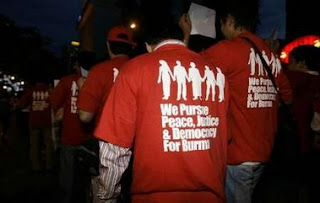
Many held small printed leaflets that read "ASEAN -- Act with Honour, Action on Burma Now".
Three people in front of the group held a large banner that read, "Listen to Burma's Desires, Don't Follow Junta's Order".

Others had written messages on pieces of paper. "Respect Human Rights Now", said one. Another said, "We welcome professor Gambari on behalf of Burmese people."
The United Nations special envoy to Myanmar, Ibrahim Gambari, arrived in Singapore Tuesday expecting to brief leaders of the Association of Southeast Asian Nations (ASEAN), who held their annual summit here Tuesday.
But as Gambari flew to Singapore, the city-state's Prime Minister Lee Hsien Loong, the summit chairman, announced the briefing was cancelled after Myanmar complained the envoy should only report to the Security Council.
Myo Myint Maung, 22, a spokesman for the demonstrators, said they were disappointed by ASEAN's response to the junta.
"We want ASEAN leaders to be more effective and more active regarding their action on Burma," he said. "We are standing here to hold a vigil to protest their statement."
The grouping has come under mounting pressure to rein in its errant member Myanmar after a September crackdown on mass protests, led by Buddhist monks, that left at least 15 people dead and sparked worldwide outrage.
Myo Myint Maung said ASEAN has taken "a very passive stance" towards Myanmar.
It is illegal in Singapore to hold a public gathering of five or more people without a police permit, meaning demonstrations are rare.
Myo Myint Maung said the group did not have a permit for the vigil which occurred a few hundred metres (yards) from the ASEAN summit venue, and just outside a special summit security zone in which even one protester is not permitted.
About 15 minutes after the vigil began, about 20 police converged on the group and asked if they had finished. They said they had, and peacefully dispersed as police recorded some of their names.
Technorati Tags: Singapore, ASEAN, Burma, Student and Protest.
Labels: Asean, Burma, Protest, Singapore, Student
UN Begins Asian Tour as Myanmar Rounds Up Activists
Myanmar's military rulers are still rounding up activists, rights groups said Sunday, even as UN envoy Ibrahim Gambari arrived in Bangkok for an Asian tour aimed at piling pressure on the generals.
As security forces in Yangon detained more pro-democracy campaigners, the junta however eased restrictions put in place at the height of last month's mass protests, relaxing a curfew here and restoring Internet access.
Amnesty International reported on Sunday that six dissidents were arrested in Yangon, Myanmar's main city, over the weekend.
The London-based human rights watchdog said the arrests were part of an ongoing crackdown by the Myanmar authorities following the army's violent end to September's protests, which left at least 13 people dead.
"Continued arrests fly in the face of the promises made this week by the Myanmar authorities to cooperate with the United Nations," Amnesty said.
Gambari, a seasoned UN troubleshooter dispatched by Secretary General Ban Ki-moon, arrived in Bangkok late Sunday to prepare for what he hopes will be a return visit to Myanmar, just two weeks ago after his last mission.
He made no comment as he landed in Bangkok ahead of talks Monday with Thailand's army-installed Prime Minister Surayud Chulanont.
Gambari was to head to Malaysia, Indonesia, India, China and Japan after his stop in Thailand.
The United States - one of Myanmar's harshest critics - is keen to see Gambari in the country without delay.
"We are encouraging special envoy Gambari to get back to Burma as soon as possible," US Secretary of State Condoleezza Rice told reporters during a trip to Israel, using Myanmar's former name.
Buddhist monks led up to 100,000 people onto the streets of Yangon in September, but the subsequent crackdown by the generals, who have ruled this country since 1962,
led to deaths and the arrests of more than 2,000.
Concern is growing for the safety of about
1,000 people still in custody, after a Thailand-based monitoring group said last week that
one activist died after being tortured during interrogation.
Amnesty said the six activists recently detained included Htay Kywe and Mi Mi, who led some of the first rallies against the regime in mid-August, warning they were at "grave risk" of torture and ill-treatment.
The UN Security Council on Thursday issued a statement deploring the regime's crackdown. It urged the junta to hold talks with the opposition led by Nobel peace laureate Aung San Suu Kyi and release political prisoners.
Myanmar's official media has labelled the statement "regrettable," but said it would cooperate with the world body.
It made no acknowledgement of the UN call for the release of political prisoners nor for it to hold dialogue with Aung San Suu Kyi.
Gambari will likely attempt to harness regional support to push the generals to adopt democratic reforms, said Debbie Stothard of the Alternative ASEAN Network on Burma, but warned that the junta appeared indifferent.
"The toll of detentions and deaths seem to be increasing, at the same time as Gambari is flying around looking for diplomatic support," she told AFP.
Two of the countries on Gambari's agenda - China and India - are key allies and trading partners of Myanmar, and are under particular pressure to take a tougher stance against the regime.
Since Gambari's last visit, Than Shwe has made a heavily conditional offer to hold talks with Aung San Suu Kyi.
He also appointed deputy labour minister Aung Kyi as a liaison officer tasked with coordinating contacts with Aung San Suu Kyi, but so far no meeting appears to have taken place.
Myanmar's state press on Sunday made no mention of the envoy's Asia tour, instead publishing accounts of pro-government rallies and lauding its own much-criticised "road map" to democracy.
"Myanmar is in the process of transforming itself into a modern and developed discipline-flourishing democratic nation," said the New Light of Myanmar, the government mouthpiece newspaper.
Technorati Tags: Myanmar, Protest, Arrest, Torture, UN and Gambari.
Labels: Arrest, Gambari, Myanmar, Protest, Torture, UN
Burmese Protestors vs Junta
PETITION: Support the Burmese protesters here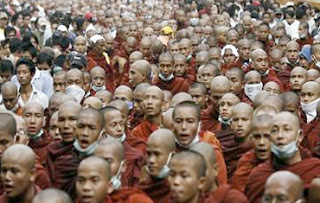
The burgundy robes of Buddhist monks usually evoke a sense of spiritual calm. But for the repressive junta that has ruled Burma for 45 years, the recent sight of shaven-headed clerics marching the streets has been anything but soothing. For more than a week now, tens of thousands of Buddhist clerics have rallied across the country, their daily alms routes turned into paths of protest. Some walked quietly with their begging bowls overturned — an implied excommunication of the military leaders whose punitive fuel hikes provoked the first demonstrations back in August. Initially, Burma's generals tried to extinguish the protests by arresting dozens of pro-democracy activists who had kick started the civil disobedience. But with the Buddhist clergy quickly taking over leadership of the movement, on Wednesday Sept. 26 the regime unleashed a violent crackdown on the protesters — a potentially dangerous move in this deeply devout nation. "The monks are the only ones who really have the trust of the people," says Khin Omar, an exiled dissident now living in Thailand. "When they speak up, people listen."
And when they act, people follow. By Sept. 24, thousands of ordinary Burmese had overcome their fear of the regime and joined the demonstrations, their shoes slapping through the monsoon downpours alongside the monks' bare feet. While marching monks recited prayers in the commercial capital Rangoon, civilians raised their fists and chanted their own mantra: "Democracy, democracy." The participation of normal citizens has turned what had been a series of sporadic rallies into the largest sustained display of dissent in Burma in nearly two decades. "The people's only weapons are their hands," said an elderly teacher watching the procession of protestors with teary eyes. "The government wants to wipe them out, but the people are not afraid."
Could this be the start of a burgundy revolution, another rebellion that upends a long-standing dictatorship? Back in 1988, the Burmese military unleashed a brutal assault on student protestors, leaving thousands dead. This time, the junta at first avoided direct confrontation with the demonstrating monks — after all, this is a country where the 300,000-plus clergy is second in numbers only to the 450,000-strong military. But this is not a regime given to restraint. With the monks' protests showing little sign of abating and civilians joining the movement in large numbers, Burma's top brass reverted to their old ways. On Monday Sept. 24, the nation's Religious Affairs Minister was quoted on state television ordering the monks back to their monasteries. The following morning, trucks mounted with loudspeakers patrolled Rangoon, threatening to arrest anyone who dared join the protesting clerics. The junta then announced a nighttime curfew and said they would enforce an already-present ban on any assembly of more than five people. By Wednesday, riot police and soldiers were stationed around pagodas in Rangoon, and hundreds of marchers had been detained.
Then the violence began, with at least two monks reported killed. As an eyewitness at Rangoon's best-known landmark, the golden Shwedagon Pagoda, tells it, the authorities had locked the famous monument's gates to prevent the monks from gathering. Security forces guarded the entrances. A little after noon, hundreds of monks, students and other Rangoon residents approached the police, sat on the road and began to pray. The troops responded quickly, pulling monks from the crowd and striking both clerics and ordinary citizens with canes. Several smoke bombs exploded, and the riot police charged. Some protestors fought back with sticks and rocks. A car was set alight — by the soldiers, claim the demonstrators — and then the air filled with the unmistakable crack of live ammunition. Soldiers were shooting volleys of bullets into the air. "They are not Buddhists," cried Thurein, a 24-year-old student, clutching half a brick and fleeing from the smoke. "They are not humans. Tell the world. We were praying peacefully and they beat us. They beat the monks, even the old ones." An elderly monk stood with him, bleeding from a baton gash on his shaven head.
The protesters regrouped, though, and surged forward again. Minutes later, a tear-gas canister arced through the air toward the pagoda's eastern entrance. The monks retreated, many still armed with clubs of scavenged wood, one brandishing a riot shield he had snatched from the police. Suddenly, there was an enormous explosion: a clap of thunder. The demonstrators applauded this sign of cosmic solidarity. One monk raised his hands to the heavens, shouting "The rain is coming! The soldiers will be struck by lightning!" Nearby, a woman responded, "Lightning is not enough. They deserve more." A cheer went up with each subsequent clap of thunder.
Eventually, the battle stopped. The clerics gathered at a nearby monastery to march downtown. But first came a chilling display of the people's anger — and the monks' moral influence. A man on a motorcycle rode up. Most motorcycles have been banned for years because, the story goes, the paranoid generals feared being shot by an assassin riding one of them. Those few people who can tool around on motorcycles are therefore assumed to be government spies. The mob pounced on the man, pulling him off his bike and raising their wooden sticks. "Beat him," they cried. "Kill him." Quickly, the monks intervened and hustled the man to the safety of a monastery. The crowd was forced to take out their ire on the motorbike, smashing it to bits with clubs and rocks. "If the monks had not saved him," said a Burmese cameraman filming the scene, "he would be dead for sure." In 1988, some lynchings of government agents were stopped by monks and students; far more were not.
Despite the clash at Shwedagon, the monks continued on, their fervor broadcast over loudspeakers: "Let us overthrow the government." By early afternoon, the demonstrators had marched the two miles to the Sule Pagoda, another holy site. Again, the path to the pagoda itself was blocked by hundreds of security forces, many with bayonets fixed. The protestors sat and prayed in front of them. More soldiers armed with rifles arrived, though, and most of the crowd stood up and walked away. Twenty minutes later, the troops opened fire — a 10-second burst above the heads of those marchers who had dared to stay. People fled, but not for long. Another column of ralliers, at least a mile long, wound through the streets to join them. But as dusk approached, the crowds dispersed again. Shops in the Sule area had been shuttered all afternoon. In a city where the streets are vibrant and bustling until late, most residents had taken refuge at home. No one wanted to be out after dark.
Other nations, most of whom greeted the '88 crackdown with silence, are keeping a much closer watch this time on the unfolding drama in Burma. On Wednesday, the U.N. Security Council convened an emergency meeting to discuss the turmoil in the country. A day before in his address to the U.N General Assembly in New York City, U.S. President George W. Bush criticized the "reign of fear" in Burma; he unveiled further restrictions on the regime, including travel bans to the U.S. for members of the junta and their families, extending sanctions that have been in place for a decade. The same day, Britain's Foreign Secretary David Miliband spoke of how "brilliant" it was to see monks march on Saturday to the home of Nobel Peace Prize laureate Aung San Suu Kyi, the daughter of the independence hero who led Burma's struggle against the British. Suu Kyi has spent much of the past 18 years under house arrest. Her National League for Democracy (NLD) won elections back in 1990, but the generals refused to honor the results. "It will be a hundred times better," said Miliband, "when she takes her rightful place as the elected leader of a free and democratic Burma."
That sentiment echoes the wishes of many in the Buddhist clergy, who through the newly formed All-Burma Monks Alliance, have called for Suu Kyi's release and, even more dramatically, the junta's expulsion "from Burmese soil forever." "We must not retreat," vows a 23-year-old monk in Rangoon. "If we retreat, we fail." Historically, Buddhist clerics have been a key element of resistance in Burma, from British colonial days through the democracy rallies in 1988. But this time, the monks are not simply adding their moral authority to the movement; they are leading the protests. The shift is significant, particularly for a junta that has tried to burnish its influence by linking itself to Buddhism. Burma's government-run newspapers regularly display generals lavishing money on building new pagodas and monasteries. "The junta has bent over backwards to show how good Buddhists they are," says Josef Silverstein, a Burma expert at Rutgers University in New Jersey. "For them to legitimize a crackdown, they will have to prove that the protests are being led by misguided monks who are actually misusing Buddhism."
Burma's generals will have a tough time convincing the public they hold more spiritual suasion than the monks. Holed up in Naypyidaw, a city that was constructed out of jungle in 2005 to replace Rangoon as the national capital, the military leaders have virtually barricaded themselves from their subjects. While ordinary Burmese get ever poorer because of the junta's economic mismanagement, the generals live in swanky mansions and drive fancy cars. The government has signed lucrative gas-pipeline and timber deals with other nations, but little of the money trickles down to ordinary people. The steep fuel hikes in August only heightened the economic disparity, as some formerly white-collar workers could no longer afford to take the bus to the office. Buddhist clerics are experiencing privation, too, since their lives depend on offerings from the people. "The monks are an economic barometer in Burma," says Sunai Phasuk, a consultant for Human Rights Watch in Bangkok. "They feel the deterioration of the economy and the hardship of their followers."
The ruling class' isolation stands in contrast to the increased connectivity of the Burmese people. Technology has revolutionized dissent. Cell phones can now be rented for $50 a month, and a click of a button sends pictures of protests to the outside world. Aung Zaw, an exiled student activist who edits the Irrawaddy, a Thailand-based publication that covers Burmese affairs, recalls how it took nearly a month for word of student protests in the early 1990s to reach Thailand. "Now we get information about protests almost instantly," he says, "and it's then sent back to people in Burma so they know what's going on across the country." The flow of information has even spawned a group of Burmese bloggers, some of whom operate out of Rangoon's 200-plus Internet cafés. (Just four years ago, there were fewer than 30 such Web cafés.) On Sept. 1, as protests against the fuel hikes were gathering momentum, 600 people showed up at the inaugural meeting of the Myanmar Bloggers Society in Rangoon. One member, a computer instructor who later witnessed Suu Kyi's Saturday meeting with the monks, uploaded a grainy digital photo she took of the momentous event. A few hours later, the picture had traveled across the globe.
Such powerful images may hearten democracy advocates worldwide, but will they persuade Burma's soldiers to disobey orders to shoot directly at the protesters? For all its economic incompetence, Burma's junta has managed to hold together the military remarkably well. Most high-level government positions are held by army officers, and lowly grunts can work their way up the ranks. Junta leader General Than Shwe, for instance, started off as a rank-and-file soldier whose psychological-warfare expertise and loyalty to predecessor Ne Win won him promotions. Still, there may be some cracks in the military's façade. "Than Shwe or senior military leaders might not care about international opinion or the feelings of the people, but some middle- and lower-ranking officers surely do," says Win Min, a Burmese military analyst based in northern Thailand. "These younger officers don't want to be hated by the people for the next 30 years."
Key to the equation may be China, Burma's largest trading partner and ideological ally. But despite calls from the West for China to use economic leverage over Burma, it's not clear how much influence Beijing really has. "China will urge Myanmar to use peaceful means to solve the problem, [because] China would like to see a stable environment in Myanmar," says Zhai Kun, an expert on Southeast Asia at the China Institutes of Contemporary International Relations in Beijing. "But because Myanmar is a closed society, I don't think they listen to advice from the outside, including China."
That puts all the more pressure on Burma's monks, as the only force whose authority can challenge that of the military. Monks have urged the generals to avoid bloodshed by sitting down for reconciliation talks with Suu Kyi's NLD. The hope is that dialogue might lead to a power-sharing agreement that recognizes the 1990 election results. So far, the junta has pointedly ignored the 62-year-old democracy activist. Indeed, recently passed constitutional guidelines bar Suu Kyi from holding power because she lacks military experience and was married to a foreigner. But Suu Kyi clearly has the vote of some in the Buddhist clergy, as evidenced by their symbolic visit to her house. "Even if they are not political, the monks hear stories about the daily struggles of the Burmese people and the repression of the junta," says Aung Naing Oo, a Burmese political analyst based in Thailand. "They feel their pain, and they cannot just sit back idly." The NLD, even with its ranks ravaged by imprisonment and exile, may be the only political alternative Burma has — and many monks know it.
Of course, no amount of Buddhist mantras chanted in Suu Kyi's name are likely to convince Burma's generals to give up power quietly. They have ruled with an iron grip, and with impunity, for nearly half a century, and have already brutally crushed one major democracy movement. With the clashes on Sept. 26, the regime once again displayed its capacity for violence. Burma's burgundy revolutionaries can only pray that their robes will not be stained further — by the color of blood.
Technorati Tags: Burma, Myanmar, Junta, Military and Protest.
Labels: Burma, Junta, Military, Myanmar, Protest
A Peaceful Demostration for APEC 2007


Scuffles between police and protesters broke out after a smaller than predicted number of demonstrators staged a short and peaceful march in central Sydney against the Asia-Pacific Economic Co-operation forum.
A massive police presence contained the largely good-natured crowd that had included families and children.
Police fears of widespread violence did not eventuate, but there was some trouble.
A police spokesman said five marchers had been arrested and two officers were injured when some trouble flared. One officer was hospitalised with unspecified head injuries. No further details were available.
About two hours after the march ended in Hyde Park, police detained another three men.
Two of the men, who were named on an APEC blacklist, were dragged away by officers, placed in a police bus but later freed.
Paddy Gibson - who had helped organise today's march - said he was in cafe in the park when he saw police grab and take away one man.
"When I started complaining and they said 'take him away as well'," he told smh.com.au.
Witnesses saw Mr Gibson grappled to the ground and then escorted from the scene. Both men were released 20 minutes later.
This afternoon lines of police were deployed on Elizabeth Street near the Sheraton on the Park Hotel, where some APEC delegates are staying. About 200 protesters remained in the park.
Organisers estimated that 10,000 people took part in this morning's march. Earlier in the week, police had ominiously predicted 20,000 might show up and warned of the danger of rioting.
Protest organisers pointed to the general good behaviour of the crowd and accused authorities of overreacting and deliberately exaggerating security concerns.
They said police had tried to browbeat demonstrators by putting hundreds of officers on the streets at huge expense to taxpayers.
"It's been an absolutely fantastic rally you should all be congratulated," Alex Bainbridge of the Stop Bush Coalition told the crowd.
As APEC leaders - including US President George Bush and Prime Minister John Howard - met at the Sydney Opera House for their summit, riot squads with shields and were deployed in some parts CBD.
The protesters gathered at Town Hall and moved slowly towards Hyde Park following a police-approved route.
Lines of police funnelled the crowd down Park Street towards the park as helicopters hovered above.
Seven buses, converted into oversized police paddy wagons, were parked in a line that blocked George Street outside the Queen Victoria Building. The recently acquired NSW Police water cannon was stationed nearby.
There was little trouble among protesters as their march took on an almost festive air.
One woman was seen being led away by officers near the QVB.
In another incident, five policemen grappled one male protester to the ground on Park Street. The man was led away by other officers as surrounding demonstrators chanted: "shame, shame".
One witness later alleged that the man had been throwing objects at some marchers in an bid to provoke trouble.
Police also led away a man who was naked except for a strategically placed sock. Across his bare chest was written: "Hey (Police Commisioner Andrew) Scipione, where's my concealed weapon?"
Many of the protesters carried placards reading: "End the occupation of Iraq", "Save the planet", "Drop Bush, not bombs" and "Put the water cannon to good use. Give Morris Iemma an enema".
Others chanted: "We are peaceful, Bush is not".
Before the rally, NSW Police Minister David Campbell said people would be free to use their democratic right to protest but officers also had a responsibility to ensure the safety of international visitors and the public.
Mr Campbell told ABC Radio organisers of the Stop Bush Coalition demonstration faced a challenge to keep the protest peaceful and not allow other groups to cause trouble.
"Of course the concern is there are other people from other organisations such as Mutiny, another group called AC/DC and a group called Resistance, who said they would come to Sydney intent on violence," Mr Campbell.
"There is concern that they might just join that demonstration and then try break out of it in some way."
The commander of the Public Order and Riot Squad , Chief Superintendent Stephen Cullen, said he feared anarchist groups would infiltrate the protest and whip it into a violent mob.
But Mr Bainbridge said police predictions of violence had been "propaganda".
"They're trying to use the talk about violence to disguise the real issues we're raising at the protest rally," he said.
Technorati Tags: APEC, Peaceful, Protest, Police and Bums.
Labels: APEC, Bums, Peaceful, Police, Protest
Police Blacklist to be Defied by Activists
Four of the Sydney people on the Police Security Blacklist last night challenged the list as unconstitutional, but their legal arguments were rejected by the NSW Court of Appeal, sitting in an extraordinary evening session. Despite losing the legal argument, the four men - Dan Jones, Paddy Gibson, Dan Robbins and Tim Davis-Frank - have declared they will defy the ban and participate in Saturday's anti-war march by the Stop Bush Coalition.
The lawyer for the four, Geoff Kennett, argued that the ban was an unconstitutional restriction of political communication, and that the NSW Police blacklist went beyond the powers of the NSW Parliament. The three Appeals Court justices said that the banning of a limited number of potentially dangerous people from a protest, in a limited area, for a limited amount of time, served the legitimate purpose of responsible government.
Police have recieved unprecedented powers in the APEC MEETING (POLICE POWERS) ACT 2007 of stop, search and detention, and confiscation of items from people, and the blacklist to exclude people from declared areas (a much wider area than restricted areas).
The Police Blacklist is believed to contain the names of 34 activists. On Tuesday 5 more people, who are associated with the FLARE in the void Convergence, were added to the list. "All of the people who are associated with the conference will defy the order,'' said spokesman Rishin Sing in a Herald report.
This morning Daniel Jones told the ABC "This march will go ahead. I think this is going to be a large demonstration and I think this will be a peaceful march," he said. "I think this will be a march that actually will show [Prime Minister] John Howard and [Opposition Leader] Kevin Rudd exactly who the opposition in Australia is. It is the public opinion... which will be represented on the streets of APEC."
Daniel Jones accused the Police list of being disciminatory as it lists people without criminal records and stops the their right of free speech. "This list is not a list of violent people that are threatening," he said. "If it was there would be rapists... on this list. I mean a rapist has more rights in the Sydney Central Business District at the moment than we do. We believe we are on this list for political reasons. We are planning only to have a demonstration, I mean, we've made no secret of that all long."
Back in June 2007 one of the four, Daniel Jones, was approached by Police Intelligence to spy on fellow activists and in return "arrangements" could be made about charges Mr Jones faces over his participation in G20 protests in Melbourne in November 2006. Rather than be co-opted and spy on his mates, Daniel took his story to the newspapers.
Technorati Tags: APEC, Protest, Blacklist, Activist and AgentProvocateur.
Labels: Activist, AgentProvocateur, APEC, Blacklist, Protest
Bush Slams Burma
Bush attends APEC in Sydney, obviously all of us would want to take to the streets and be heard. John Howard implements all sorts of "security equipment" tall fences, water canon and even a ban list.
Now Bush goes to Sydney and slams Burma for their crackdown on protest marches. The sheer irony.
$$$$$$$$$$$$$$$$$$$$$$$$$$
US PRESIDENT George Bush has slammed Burma's military regime, promising to use the APEC conference to speak out against a crackdown on protest marches.
"It's inexcusable that we've got this kind of tyrannical behaviour in Asia," Mr Bush said at a press conference with Prime Minister John Howard.
Small bands of Burmese took to the streets of the capital, Rangoon, to protest at a Government hike in petrol prices. In some cases, the cost of fuel soared by five times. In response, regime-sponsored gangs beat protest leaders. So far, the military has stayed in its barracks.
The Burmese junta is sensitive to organised protests, fearing they could become a campaign for political change.
Protests in 1988 opened the way for elections two years later, won by the National League for Democracy, the party led by Nobel peace prizewinner Aung San Suu Kyi. The military refused to accept the result, keeping Ms Suu Kyi under house arrest for much of the time since.
Mr Bush yesterday said people in free societies needed to speak out against human rights abuses.
Australia has a ban on military exports to Burma and visits by senior regime figures. Last week, Labor's foreign affairs spokesman, Robert McClelland, called on the Government to condemn the latest crackdown.
Technorati Tags: APEC, GeorgeBush, Burma, JohnHoward and Protest.
Labels: APEC, Burma, George Bush, John Howard, Protest
APEC: Police Want Court Order Against Protestors
New South Wales Police will today seek a Supreme Court order to prevent the biggest APEC protest planned for this Saturday.
Police have been in discussions with the Stop Bush Coalition for weeks over their proposed route for a protest march this Saturday.
There is a clear signal today that those negotiations have failed, with police confirming they will take the issue to the Supreme Court.
The group's leader, Alex Bainbridge, says police gave him a letter last night to say he would receive a court summons today.
Mr Bainbridge says the group is ready to take on the legal challenge.
"We have lawyers that are prepared to work with us because they also believe in the rights of the democratic protests," he said.
Police object to the proposed route because it includes the declared APEC zone of Martin Place.
In declared zones, officers have more powers to search people and move them on.
But Mr Bainbridge says it is not a restricted area and protesters should be allowed to be in the same space as the rest of the public.
"We are planning to enter the declared area, which is open to the public," he said.
"It's nowhere near the restricted area or any of the APEC venues, and what we believe is that nowhere that is open to the public should have protests banned or free speech restricted."
The Stop Bush Coalition has said it was always prepared for court action.
The group is hoping to attract up to 10,000 people to the demonstration.
Meanwhile, the Roads and Traffic Authority says there are extensive delays for northbound motorists on Sydney's Eastern Distributor because of the installation of a security fence for APEC.
Technorati Tags: APEC, Sydney, Protest and CourtOrder.
Labels: APEC, Court Order, Protest, Sydney
APEC: Undercover Policemen and Restriction Pamphlets
APEC, the 8 day long meetings have Sydneysiders issued with restriction pamphlets in their home ground. The NSW police indicate that they "will do everything in their power to ensure that the public are safe from violent protests during APEC". Will there be an agent provocateur? To this, they do not say.
$$$$$$$$$$$$$$$$$$$
NSW Police have hit back at concerns that undercover officers might be planted among APEC protesters to provoke violence.The concerns have been raised by the NSW Greens after Canadian Police admitted planting undercover officers at a protest against a North American leaders' summit in Quebec last week.
Demonstrators claim the undercover officers were trying to provoke violence while Quebec police officials said their officers were mingling with protesters to identify those who might become violent, The Toronto Star reported.
The NSW Greens today called on the NSW Premier to guarantee that there would be no undercover police nor other security agents attempting to provoke violence during APEC demonstrations.
"In light of the admission by Canadian police that the men photographed with bandanas and rocks were undercover police officers, I call on the Premier give a public assurance to the people of NSW that similar tactics will not be employed by NSW Police or other security agencies during the APEC meeting," Greens member Sylvia Hale said.
"I have been concerned about the provocative nature of many of the recent statements by the Premier and the Police Minister and I want an assurance that the police will not be trying to manufacture an excuse for giving their new APEC powers and weapons a workout."
Ms Hale admitted she had no evidence any Australian police or security force would plant "agent provocateurs" in the crowds at APEC demonstrations.
"I don't have any direct proof. I'm definitely not saying that I have any evidence that this will happen."
NSW Police and the State Government have denied that police would provoke violence during the demonstrations.
A NSW Police spokeswoman said: "NSW Police Force does not use its officers to provoke violence in any situation."
Deputy Premier John Watkins said any protester who broke the law would be dealt with in terms of special APEC laws.
"NSW Police will do everything in their power to ensure that the public are safe from violent protests during APEC," he said.
"NSW Police have been working hard with protesters in the lead-up to APEC to minimise the disruption to Sydneysiders."
The main APEC protest is planned for Saturday, September 8, when thousands are expected to gather at Town Hall for a march.
The Quebec provincial police were forced to admit last week that they had planted undercover officers amid protesters after a damning video surfaced on
YouTube, The Toronto Star reported.
The video shows three masked men being confronted by a protest organiser.
The organiser makes it clear the men are not welcomed and tells the crowd they are police officers.
Confronted by the crowd and the organiser, the men - one of whom is holding a rock in his hand - push towards the police line where they are shoved to the ground and handcuffed.
A photo that emerged last week shows the soles of the men's boots adorned by the same yellow triangles that a police officer kneeling next to him has on his boots, the paper reported.
$$$$$$$$$$$$$$$$$$$
Sydneysiders to receive APEC restrictions pamphletRelated Story: More APEC restrictions announced for Sydney Residents in 16 postcodes around the Sydney CBD should this week receive a brochure explaining changes about traffic and transport during the APEC summit.
The four-page pamphlet includes maps, access to public venues and contact details.
The Federal Government spokeswoman for APEC, Anne Fulwood, says residents in Bondi will also be letter-dropped.
"The most important parts of that would include road closures and access to their residences and so on," she said.
"That's probably the most important thing during those days when areas might be closed off, for example, on the Sunday in Bondi when Icebergs is hosting Mrs Howard's leaders' spouses luncheon - there are certain restrictions then."
Technorati Tags: APEC, Sydney, Restriction, Police, Protest and AgentProvocateur.
Labels: AgentProvocateur, APEC, Police, Protest, Restrictions, Sydney
APEC Protest Group Swells
Activists and unions expect more than 10,000 to protest during APEC. The main student protester organisation, the Stop Bush Coalition, had originally estimated that 5000 people would March on Saturday, September 8.
The APEC Taskforce expects 5000 summit-related delegates to attend the summit, while there will be a contingent of more than 5000 police and defence force in Sydney during Leaders' Week from September 2 to 9.
A meeting on Monday night which included the Fire Brigade Employees Union and the Maritime Union of Australia decided to change the route of the protest to avoid a direct confrontation with police, according to an attendee.
The protest group originally told police that the march would start at Town Hall, in George Street, go down to Circular Quay and then stop outside the Opera House for a festival.
The Opera House falls within an APEC restricted area and police have said entry will only be allowed to accredited individuals.
It is understood the unions favoured a more conservative route that would avoid a direct confrontation with police, according to an attendee at the event.
The protesters now intend to march from Town Hall, in George Street, to outside the US Consulate in Martin Place - in the APEC declared area - before having a festival in Hyde Park, according to an attendee at the meeting.
Police have extraordinary powers to stop and search individuals in the declared area during the APEC summit.
Protest organisers are frustrated with police from the APEC command who have yet to respond formally to their Schedule One despite the document being submitted in May.
"We're going to put every effort to get over 10,000 marchers," said the attendee. "I suspect you will see people also having smaller protests there on the Friday.''
The protesters are also angry with police who accuse them of planning violent protest during the summit.
"The police have been characterising the demonstrators who will be protesting outside APEC as having a violent agenda and of wanting a confrontation with police," said Jim Casey from the NSW Fire Brigade Employees Union.
"At best police are misinformed and at worse they are trying to paint us as something we're not. We're extremely clear that this will be a peaceful demonstration.''
smh.com.au reported last week that a training video used by riot police feature members of the MUA and implied they would take part in violent protest.
Mr Casey said the new route would reduce the chance of a direct confrontation with police.
"It was simply felt that police were being hypersensitive and the Martin Place was seen as more inoffensive proposal," he said. "There's real concern because we have an open and public commitment to engage in peaceful demonstration on the eighth of September.''
The head of the police APEC command, Peter Lennon, said in a July interview he expected violent protest.
"I think there will be a violent protest but my appeal to the people is, is there any other way that we can just sort this out whereby we do it in a mature fashion, where we allocate you the space where you can stand on that corner and walk on that street and you can have your protest and there will be media because protesters gather media," he said
Mr Lennon also said at the time that protesters would not be able to reach the Opera House.
"Getting to the Opera House I think there are going to be some difficulties because they're getting close to a venue where these leaders are," he said.
While Mr Lennon said he expected violent protest he also admitted there was no black list of banned protesters because they had not identified anyone dangerous enough.
"If we found someone who we would have to exclude, then we would have to go and inform that person,'' he said. "But we have not come across any people that come anywhere near that."
Technorati Tags: IMF, WTO and Protest.
Labels: APEC, Protest, Sydney
Agent Provocateur Revealed
The German goverment uses instigators to validate police presenceAt a G8 summit blockade near Bad Doberan, following repeated media warnings, a so-called "agent provocateur" has been unveiled. This violence provoking state employee has sneaked into the peaceful anti-G8 sit-in action and instigated people to violent deeds.
Apparently, various activists have tried to hold back until this unmasked guy, who showed up and let loose his aggressive temper. He urged people around him to use violence. But eventually some protesters identified this man in black with a policeman.
When the news about this man's identity went round, activists literally mobbed him. The agent provocateur was freed by some Legal Team members from the mess he'd got himself into and he was handed over to his police colleagues.
During the clashes between anti-capitalist globalization protesters and police it had already been cried out that violence by state paid agents provocateurs had massively contributed to the escalation of 2nd June in Rostock.
So far, 200 arrests have been made today, of which 60-70 were arrested in a parking lot near the Rostock Laage airport. Two lawyers were not allowed through but, instead, warned that if they came back they would be arrested. At both detention centres in Ulmen and Industriestr., all lawyers were kicked out of the the lawyers room. An alternative media bus from Amsterdam was seized by police and the driver was physically forced to drive the bus. A Stern photographer was arrested for "inciting violence".
Technorati Tags: G8, Protest, Rostock, Arrest and AgentProvocateur.
Labels: AgentProvocateur, Arrest, G8, Protest, Rostock
Police Brutality Ahead of Talks
The German police took to the offensive, even before the meetings begin.

Police gearing up. Is this necessary?

3 Policemen taking down a protestor

Policeman 2512 stomping on protestor

Blasting the water canon at 2 persons holding a banner

Sneaky bastard attack

We come in peace and will not be intimidated.
Meanwhile, having Africa on the agenda has been a headache for the German government. Their concern is that the only story on the G8 and Africa will be about broken promises and how delivery of the 2005 pledges is disastrously off track. In the past few weeks, the German chancellor, Angela Merkel, has been looking for a good news story - an announcement of an increase in German aid of around €2bn (£1.35bn) is likely - to mask the fact that the G8's agreement in Gleneagles is in danger of falling apart. It has gone to the wire, with still no agreement on how to word the commitment to the 2005 deal. More "sherpa" meetings of officials will be held today and tomorrow ahead of the summit opening on Wednesday.
Technorati Tags: G8, Germany, Police, Violence and Protest.
Labels: G8, Germany, Police, Protest, Violence
German Police Use Stasi Scent Profiling on G8 Protestors
This is getting more and more absurd
!@#$!@#$!@#$!@#$!@#$!@#$!@!@#$
Stasi scent-tracking methods are being used to keep a check on selected protesters planning to demonstrate at next month's G8 summit.
Scent traces collected directly from everything from people's palm sweat to their vests and cigarette lighters have been made available to investigators so that sniffer dogs can detect potentially violent protesters, federal prosecutors confirmed yesterday following reports in the German media.
"This has happened to several suspects," said Andreas Christeleit, a spokesman for the prosecutors. It is believed that most samples were collected during recent early-morning raids across Germany.
The revelations have immediately led to comparisons with the methods of the former East Germany's secret police, the Stasi, who habitually collected the scents of dissidents to identify suspects at a later date. It was thought that such chilling espionage techniques had been consigned to history.
But the news that similar methods are to be deployed at the upcoming summit in a democratic Germany has further angered activists already fuming over the construction of a 7.5-mile barbed-wire fence around the venue, at Heiligendamm on the Baltic coast.
"[This is] another step away from a democratic state of law towards a preventive security state," said Petra Pau, a member of the opposition Left party. "A state that adopts the methods of the East German Stasi robs itself of every legitimacy."
But according to experts it is as legal as collecting fingerprints. Scientists looking to expand the use of smell banks say it is possible to determine someone's age, their sex and any illnesses they might have through traces of their body odour.
A 68-year-old atomic energy protester from Hamburg, identified by police as a possible danger to the G8 summit, reported how investigators knocked on his door at 8am and demanded scent samples from him.
The man said he was made to hold metal pipes in his hands - as palms give off an immediate scent - which were then sealed and marked with his name before being taken away.
The police have responded to the reports by saying that they are trying to find out the sender of letters confessing to 14 arson attacks in the Hamburg and Berlin areas which are believed to be connected to the anti-G8 movement. They hope that a scent register will help them to do so. Police say they suspect that the same people are planning fire bombs and other attacks on the June 6-8 meeting.
Summit opponents are trying through the courts to lift a ban on a so-called "star march" planned at Heiligendamm on June 7, introduced after an interior ministry decision to prevent protesters coming within five miles of the resort.
The number of car burnings in Berlin has risen considerably over the past fortnight as tension rises, as have incidences of anti-G8 graffiti.
Technorati Tags: G8, Germany, Stasi, Profile, Protest and Protestor.
Labels: G8, Germany, Profile, Protest, Protestor, Stasi
Urgent Appeal Against G8 Demo Ban
Last year, the World Bank and IMF chose Singapore as the venue for the meetings knowing that the country has little tolerance for demonstrations. This time, Germany follows suit.
!@#$!@#$!@$!@#$!@#$!@#$!@#$
- G8: Urgent appeal lodged against demonstration ban. If necessary, the ’star-march’ coalition plan to take matters all the way to the federal courts.
- G8 countries’ foreign policies are given as the reason for the “police emergency”.
Press Release May 18th 2007 [Gipfelsoli Infogruppe | International Press Group]
All demonstrations in the vicinity of Heiligendamm have been prohibited under a General Ban issued by the German Office for Association. The grounds behind the fence and a 4 kilometre area around the perimetre of the fence fall under the ban. With this ban, the protests are to be held at a 6 kilometre distance.The planned ’star march’ is one of the initiatives that is affected by these measures. With the motto, ‘taking the protest to Heiligendamm’, the star march is intended to end with a closing rally in Heiligendamm. Today, the star march coalition is lodging an urgent appeal against the ruling. A decision is expected at the end of next week. “If necessary, we will have our right to protest confirmed by the federal courts”, a speaker for the star march coalition said. The prohibited area stretches from the camp in Reddelich almost all the way to the camp in Wichmannsdorf. A speaker of the BAO “Kavala” has declared that a congregation of 3 people within this area is illegal under the ruling. “This means that we can’t even leave the camp in groups of 3 and walk next to one another without the police breaking us up”, says a camp participant of the WomenLesbianTransgender Network. The rationale for the ban, according to “Kavala”, lies with the foreign policies of the G8 countries. A “latent threat situation” exists for the representatives of the G8 countries because of the wars in “Iraq, Lebanon, Syria, Iran, Afghanistan, Pakistan and Palestine”. Even the German Government is perceived as endangered, because of its “increasing engagement in conflict regions”. What is meant is the war in Afghanistan.
Hanne Jobst of the Gipfelsoli Infogruppe finds this reasoning absurd: “Protest is forbidden because it would have negative effects for foreign decision-makers. The G8 makes decisions that affect the lives of millions of people every day, without the legitimacy to do so, yet inthe opinion of the police, the G8 should not have to be subjected to these people’s anger”.
Even popstar Herbert Groenemeyer has to admit this: “There is real anger”, he explained in the German newspaper ‘taz’ the day before yesterday.
Conicidentally, this week in Scotland, charges against five activists who were arrested and detained on their way to a closing demonstration at the conference hotel in Gleneagles during the 2005 G8 summit, were dropped. “As always during summit protests the police use arbitrary and often illegal measures to prevent protest from reaching those it seeks to criticise”, Gerda Achterhuis of the Dutch Dissent network argues.
“The move to ban the demonstration does not surprise us. However, we will not let ourselves be intimidated and will continue to mobilise for the star march and all other actions against the G8 meeting.”
Gipfelsoli Infogruppe: +49 0160 95314023
International Press Group: +49 160 92437902
Background:
Public statement of the police department Rostock (detailed justification for the ban, 23 pages)
Technorati Tags: G8, Appeal, Protest, Ban, Dissent and Oppress.
Labels: Appeal, Dissent, G8, Oppress, Protest, World Bank