Like Undead, G20 Controversy Keeps Coming Back For More
By:
Pittsburgh Foreign Policy Examiner, Nick Lewandowski
Perhaps in honor of Halloween, the G20 controversy refuses to die.
The Post-Gazette reports that the Pittsburgh Citizen Police Review Board has scheduled November 10th as the tentative date for its Oakland hearing on police conduct during the G-20 Summit. Last week, the Review Board held a meeting in Lawrenceville to hear a number of complaints of misguided arrests and excessive force - including one involving a woman arrested on her way to a date. While making her way past protesters the woman was ordered to disperse, but could not move fast enough because of her high heels.
The Oakland meeting will thus follow what Board Director Elizabeth Pittinger called a "well-received" meeting that "verified some things."
The Board has already received some 75 complaints, most similar to those heard in Lawrenceville.
"The problem wasn't so much on the street level, where the officers acted," Pittinger commented, "but in the higher level of the planning [...we want to look at the tactics and equipment that were deployed."
Pittinger and others are now working with the Densus Group - an international security consultancy - to develop a detailed report of security-related events during the summit. In addition, a group called What Happened at Pitt (WHAP) - made up of University of Pittsburgh students arrested during the G-20 and their supporters - has expressed interest in holding the November hearing on the university campus. WHAP primarily seeks to raise awareness of its members' legal woes and money for their respective defenses.
The Police Citizen Review Board eventually intends to publish a report that will be useful for cities all over the world hosting major international events.
Let's hope it hits print before this monstrous legal debacle shambles into the new year.
Labels: G20, Meeting, Oakland, Pittsburgh, Police Conduct, Review
Tweets Criminalized in Pittsburgh G20 Crackdown
By: David Roknich
"
Government authorities act like government authorities in Moldova and China and Iran, where they like it when people have access to information, be it radio stations, newspapers, free press, in other countries, but they’re uncomfortable with it in their own country. And in this case, they decided to try to criminalize it." - Elliot Madison, interviewed by DEMOCRACY NOW!
Elliot Madison was interviewed by Democracy Now! shortly after his home was broken into by FBI agents, as the results of his "Tweets" sent during the G20 protests in Pittsburgh. The Electronic Frontier Foundation has made some of his
court documents available in scanned form. I expect to have the docket available as text soon. Meanwhile, here is the transcript of Elliot Madison interviewed by DEMOCRACY NOW!
SHARIF ABDEL KOUDDOUS: For our first segment, we turn to a case of a New York activist who’s believed to be among the first to face criminal charges for communicating electronically with protesters about police actions. Elliot Madison was arrested last month during the G-20 protests in Pittsburgh when police raided his hotel room. Police say Madison and a co-defendant used computers and a radio scanner to track police movements and then passed on that information to protesters using cell phones and the social networking site Twitter. Madison is being charged with hindering apprehension or prosecution, criminal use of a communication facility, and possession of instruments of crime.
Exactly one week later, Madison’s New York home was raided by FBI agents, who conducted a sixteen-hour search. The agents seized items including computers, clothing, books and the records of Madison’s clients in his job as a social worker. Madison has since won a temporary order barring agents from examining his seized property.
For more, Elliot Madison joins us here in the firehouse studio. We’re also joined by his attorney, Martin Stolar.
We welcome you both to Democracy Now!
ELLIOT MADISON: Thank you.
MARTIN STOLAR: Thank you, Sharif.
SHARIF ABDEL KOUDDOUS: Elliot, let’s begin with you. Begin by describing exactly what you were doing in Pittsburgh during the G-20 and your subsequent arrest.
ELLIOT MADISON: Well, there were protests during the G-20, and a group of people came together called the Tin Can Comm—Communications—Collective. And they were putting up basically message boards. There was a message board for food. There was a message board for legal. There was a general message board. There was a message board just for announcements.
And how Twitter works is, traditionally people can text one—instead of just texting from me to you, I could text everyone that chose to follow me, OK? So, the only difference in this setup is that we allowed points to go to everybody in the group. So, if Martin wanted to text you and me, he could. If I wanted to text the two of you, I could. So it was a point of access issue. So it changed Twitter and made it more decentralized, so people could carry on a conversation knowing that people were spread out throughout the city. Sometimes it gets loud and noisy, and it was a way for people to communicate, not substantially different than the way the three of us are talking now.
SHARIF ABDEL KOUDDOUS: And what exactly—what kind of messages were people putting out on this site?
ELLIOT MADISON: All sorts of messages. We put on the—about different trainings. There was a Know Your Rights training. We talked about the—there were messages I received about the raid on the Just Seeds food bus. There was information about where meet-ups were for different marches, like the students’ march. To be honest, I didn’t see most of the messages, because I was arrested very early on Thursday.
SHARIF ABDEL KOUDDOUS: That’s the first day of the G-20.
ELLIOT MADISON: The first day. So, before the first day, there weren’t many messages, because there were just a few announcements about, you know, different meetings and things like that.
And the thing to remember is this was a public site. I mean, the AP articles with the lieutenant detective of operations says he was on our LISTSERV. CNN said they were on our LISTSERV. I mean, a whole variety of journalists, New York Times journalists, joined. Anybody could join. It was a public number. We don’t know who joined. It wasn’t important. And anybody could send information to the group, and it would be sent out to everybody.
SHARIF ABDEL KOUDDOUS: And so, you were sitting in your hotel room, and the police came in. Describe what happened.
ELLIOT MADISON: Where there was a—door was flung open. I assume they had a key.
Just to be clear, the hotel room was under our names. Our car was parked right out front. We weren’t doing anything clandestine, weren’t expecting the police to come in.
A number of agents from the state police came in and—you know, with guns drawn, and held us for about an hour in handcuffs, though we weren’t arrested at that time, and told us we were free to go. But we decided to stay and watch them and wait for the warrant. We weren’t presented a warrant right away. A warrant finally came, but it’s a sealed warrant, so we only got to see the face sheet of it. We don’t know why—we know what they were looking for, but we don’t know the—how they got the information, because it’s sealed. According to the face sheet, it’s eighteen pages long.
SHARIF ABDEL KOUDDOUS: And Martin Stolar, explain the charges. They include charged with hindering apprehension or prosecution, criminal use of a communication facility, and possession of instruments of crime. What does that mean?
MARTIN STOLAR: Essentially, what Elliot is charged with is using the computer or the cell phone to put up an announcement that said that the police had issued an order to disperse. Having done that and having informed people that the police had issued the order, then it is claimed that that announcement hindered prosecution somehow by, I guess, having people avoid being arrested. It would seem to me that that is something that provides some benefit to the police department, in terms of saving them the expenditure of resources in processing people. But they’ve decided to criminalize that communication, or at least in their complaint that’s what they say, that the communication that said, “Hey, there’s been a dispersal order; everybody be aware of it,” somehow turns into a crime of hindering prosecution. The communication facility then, the cell phone or the computer that was used to post that message, becomes an instrument of the crime, and the use of that mass communication facility becomes, they claim under Pennsylvania law, a third crime.
This is just unbelievable. It is the thinnest, silliest case that I’ve ever seen. It tends to criminalize support services for people who are involved in lawful protest activity. And it’s just shocking that somebody could be arrested for essentially walking next to somebody and saying, “Hey, don’t go down that street, because the police have issued an order to disperse. Stay away from there.” All of a sudden, essentially, that becomes the crime that Elliot and his co-defendant are charged with.
SHARIF ABDEL KOUDDOUS: And they may be the first to be charged criminally with sending information electronically to protesters about the police. What’s the significance of this in terms of First Amendment rights?
MARTIN STOLAR: It—
ELLIOT MADISON: Can I just clarify it?
MARTIN STOLAR: Sure.
ELLIOT MADISON: We’re not—we’re not the first. We’re the first in this country. During the Twitter revolution going on in Iran, in Moldova, in Guatemala, in the earlier newscast about Honduras, in all those cases, repressive governments have arrested folks for using Twitter. The only difference is, in all those cases the State Department, the US State Department, has condemned the arrest of these Twitter activists and had gone so far in the Iranian situation, the State Department, according to an article, asked Twitter to postpone its regular maintenance so as not to interfere with Iranian protesters to be able to send out their tweets. So the only difference is we’re the first arrested here. But this is a—over the past two years, repressive governments have been arresting people. The only difference is, the State Department has supported—I’m expecting the State Department will come out and support us also.
MARTIN STOLAR: Oh, you think so, do you?
SHARIF ABDEL KOUDDOUS: Well—
MARTIN STOLAR: I mean, it is shocking. This is really the first case, and my preliminary research has found that this is the only case where people involved in protest activity have been arrested for using or for passing out information. Essentially, this country has the First Amendment. The First Amendment protects speech, and it protects protest activity. And what Elliot and his co-defendant are accused of doing tends to support speech and protest activity itself. It is speech that goes out. Putting something up on Twitter is a form of speech. And we have some serious First Amendment problems in connection with the prosecution in Pennsylvania.
SHARIF ABDEL KOUDDOUS: And I want to say, we did contact Twitter and the FBI to invite them on the program. They both declined our request. Twitter didn’t respond. But to what extent did Twitter cooperate with the police?
MARTIN STOLAR: We don’t know.
ELLIOT MADISON: We don’t know.
MARTIN STOLAR: We don’t know. We don’t know if Twitter is cooperating with the police. We don’t know if Twitter has been asked to cooperate with the police. Twitter essentially is neutral here. The police could have logged onto Twitter and seen whatever was being posted, in the same way that individuals can log onto the police radio bands and emergency service responders, all of which is up on the internet. If Elliot is receiving from the internet notice that an order to disperse has been issued at a particular location and passes that public information on to other members of the public, that’s protected speech. It is inconceivable that that could be a crime. But that’s what he’s charged with.
SHARIF ABDEL KOUDDOUS: So, a week later after your arrest, the FBI raids your home in Queens. What happened?
ELLIOT MADISON: About 6:00 in the morning, the FBI, on a Thursday, broke into the door—we don’t know if there was a knock or not, because we were asleep—stormed up with guns—it was about twenty or so agents with Joint Terrorist Task Force; it was a combination of FBI and NYPD—and handcuffed me and my housemates, held us for a few hours, two or three hours, in handcuffs, wouldn’t let us talk, wouldn’t let us make phone calls, wouldn’t let us get dressed, because we were all asleep. And eventually, sometime after that point, they showed us a warrant. They wouldn’t let us read the warrant; they just showed it to us. Our hands were cuffed behind our back. And for sixteen hours, proceeded to take everything, from plush toys to kitchen magnets and lots of books.
I’m an author. I’ve written fiction. I’ve written lots of nonfiction. I’m an anarchist, so I’ve written lots of political works. So they not only grabbed all of my works, and they grabbed anything that they felt like grabbing from our pretty large library.
SHARIF ABDEL KOUDDOUS: And they apparently took photos, as well, posters—
ELLIOT MADISON: Yeah.
SHARIF ABDEL KOUDDOUS: —from the walls, one of Lenin and one of Curious George, apparently?
ELLIOT MADISON: Yes, yes, and they took Curious George stuffed animals. They took magnets from the refrigerator. They took a needlepoint of Lenin that my wife’s grandmother had made, a whole variety of bizarre things that they’ve taken. We don’t know everything they took, because the voucher we received is fairly vague. It will say something like “documents.” So, since the house was tossed, it’s hard to tell if the documents are just lost or if they’re, you know, seized at this point.
SHARIF ABDEL KOUDDOUS: Martin Stolar?
MARTIN STOLAR: Well, I mean, the search was just extensive. And the problem with the search warrant, which actually asked for evidence that indicated that potentially there were violations of federal rioting laws, this is the same law that was used to prosecute the Chicago Eight following the Republican Convention in Chicago in 1968. Well, what would be evidence of violations of federal rioting laws is open to question. Anarchist literature? Fiction writings that Elliot has written? Pictures of Lenin? It’s completely vague.
And so, they rambled around and searched and pulled things. They’re not only from Elliot and his wife Elena’s property, but also there were other residents of the house who are living there who had their private property taken and swept up in this, including computers and discs of somebody who’s making a film, computers and discs of somebody who produced a weekly radio show, a computer that actually belonged to the United States government. One of the residents of the house was a contract employee for one of the federal agencies, and that computer was also taken.
So, in response to that, we immediately went to federal court to say, “Hey, wait a minute. You can’t take all this stuff. This is all sorts of private property that has nothing to do with the violation of federal rioting laws, and we want it back.” And we got a federal judge to say, “Maybe you have a point there. FBI, don’t examine the boxes that you seized. Hold on, until I can examine this and issue a further order of the court.” And so, that’s what she did. She stopped them from going through the boxes, stopped them from going through and indexing, cataloging and analyzing what had been seized at the house. And that’s on hold, pending further briefing in court and pending further order of the court, which will happen a week from Friday.
SHARIF ABDEL KOUDDOUS: And Elliot, you spoke about how—the so-called Twitter revolution in Iran and how that was portrayed and condemned by the State Department in this country. I just want to go back to those days during the so-called green revolution in Iran and how the media in this country, the corporate media, the news networks, covered the use of Twitter in the protest. Let’s go to a clip of them.
FOX 11 ANCHOR: Iranians are turning to social media websites like Twitter and Facebook to tell their stories.
UNIDENTIFIED: Twitter.
MARTIN SAVIDGE: Twitter.
UNIDENTIFIED: Twitter.
HOWARD KURTZ: Has Twitter become the CNN of the masses?
KIRAN CHETRY: Here’s what some people have been tweeting about.
SCOTT HURLEY: Just type in “#iranelection.”
The US State Department actually asked the website to put off scheduled computer maintenance.
IAN KELLY: This is about the Iranian people. This is about the—getting their voices a chance to be heard.
ISHA SESAY: More and more tweets were appearing.
UNIDENTIFIED: Twitter.
KEITH OLBERMANN: A Twitter revolution.
BRIAN WILLIAMS: Is this the first true internet uprising?
RACHEL MADDOW: This revolution might not be televised, but it is definitely being tweeted.
SHARIF ABDEL KOUDDOUS: Elliot Madison, some of the coverage back in summer of the Iranian uprising following the elections. Everyone’s supporting Twitter, the State Department actually asking Twitter not to—not to do an update. And now you’re being arrested for using Twitter. We’re not seeing the same kind of coverage. Your thoughts?
ELLIOT MADISON: Yeah, I think it’s a clear case where, you know, the government authorities act like government authorities in Moldova and China and Iran, where they like it when people have access to information, be it radio stations, newspapers, free press, in other countries, but they’re uncomfortable with it in their own country. And in this case, they decided to try to criminalize it.
And I think what’s very interesting in all these stories about me is that the Tin Can Communications Collective was one Twitter feed. I have found that there were at least twenty-four Twitter feeds going on, everywhere from the police to the G-20 to Ron Paul supporters. Everybody had their own Twitter feeds going on. They decided to criminalize me, I think, because of the fact that we were in solidarity with the protesters.
SHARIF ABDEL KOUDDOUS: Well, Elliot Madison and Martin Stolar, I want to thank you very much for joining us. We’ll continue to follow this story.
The complete transcript above is from this morning's DEMOCRACY NOW!, redistributed under the terms of the Creative Commons License
Labels: Activist, Elliot Madison, G20, Pittsburgh, Prosecution, Tweets, Twitter
The G-20 Gets Overambitious
Oxford AnalyticaWith economies around the world showing signs of recovery, the G-20 ran the risk of losing momentum and relevance. The Pittsburgh summit was successful in presenting a series of actions that should keep the need for dialogue on global economic coordination firmly in the spotlight.
Global economic framework. The G-20 officially launched a Framework for Strong, Sustainable and Balanced Growth, which is to be formally established on Nov. 6-7 during the G-20 Finance Ministers and Central Bank Governors Meeting. It aims to be a process of mutual assessment of policy frameworks and their implications for the pattern and sustainability of global growth, while trying to identify potential risks to financial stability. Supposedly, G-20 members will agree on shared policy objectives, with the aim of having collectively consistent policies, which receive constant IMF support.
However, it is unclear why such a scheme was launched, unless it aims to support "difficult" domestic policies, under a mantle of global cooperation. The only recent similar arrangement was the "multilateral consultation" on global imbalances, which the IMF launched in 2006, with participation from the United States, China, Japan, the euro-area and Saudi Arabia. This did little to push those consulted to address the problem--rather, imbalances have corrected due to the global financial crisis. It is telling that the IMF has not launched a second multilateral consultation.
Doha test. Successful conclusion of the Doha Round will be seen as one of the first challenges for the Framework. The stated G-20 aim is to conclude it next year, with trade ministers instructed to make significant progress by early 2010. However, the fact that the G-20 stated that it would review progress in its next meeting (in Canada in June) is not an encouraging indication of its expectations for relatively rapid progress.
IMF vote shift. A firm commitment was made to implement a shift in IMF quota shares of at least 5% from advanced to emerging economies by early 2011. This move was approved in 2008, and took several years to negotiate. This will imply a significant surrender of votes for some countries, mostly European. Yet no specifics were offered on the size and composition of the Executive Board, another thorny issue for emerging economies such as Brazil and India.
Strengthening financial regulation. In sharp contrast to the Framework, the G-20 was specific, and realistic, in its aim of strengthening the international financial system. The Financial Stability Board would play a central role implementing proposals to:
--develop internationally agreed rules by the end of 2010 to strengthen the quality of bank capital and mitigate pro-cyclicality, with the aim of implementing them fully by the end of 2012 (if the global economy has recovered fully from the crisis);
--improve over-the-counter derivatives markets, with all standardized OTC derivative contracts traded on exchanges or electronic trading platforms, where appropriate, at the latest by the end of 2012--non-centrally cleared contracts would be subject to higher capital requirements;
--develop internationally consistent firm-specific contingency and resolution plans by the end of 2010 for systemically important financial firms; and
--achieve a single set of high-quality, global accounting standards by mid-2011.
Bonus fudge. On the controversial issue of compensation for bankers, the G-20 adopted principles that bonuses should avoid excessive risk-taking; be aligned with long-term value creation and subject to clawback; and be transparent. More significantly, the G-20 may induce financial regulators to require corrective measures, such as higher capital requirements, to firms that fail to implement sound compensation practices.
Outlook. Even if the G-20 turns out to be something of a symbolic body rather than an organ of power, it should keep the need for global economic coordination in the spotlight. Its aim to spearhead unprecedented global economic cooperation is overambitious and may create excessive expectations. However, the strengthening of financial regulations, due to be implemented during 2010-12, is achievable.
To read an extended version of this article, log on to Oxford Analytica's Web site.Oxford Analytica is an independent strategic-consulting firm drawing on a network of more than 1,000 scholar experts at Oxford and other leading universities and research institutions around the world. For more information, please visit
here.
Labels: G20, Pittsburgh, United States of America
G-20 - Vows Against Protectionism Not Always Kept
By David J. Lynch, USA TODAY
As President
Obama and other leaders of the G-20 nations prepare to meet today in Pittsburgh, it's worth recalling what became of their previous promises.
At earlier summits, G-20 leaders solemnly vowed to refrain from worsening the crisis by erecting new trade barriers — then returned home and promptly began erecting new trade barriers.
Since November's Washington gathering, G-20 members have enacted about 100 separate trade-restricting provisions. Last week, for example, the U.S. announced a 35% tariff in response to what it called a damaging surge of Chinese-made tires.
"On average, a G-20 member has broken the no-protectionism pledge every three days," concludes a study by the Centre for Economic Policy Research in London. Still, the largest impact on world trade has come from the credit crunch and recession. This summit, expected to center on a U.S. proposal to rebalance the global economy, is likely to yield a renewed endorsement of open markets. "We're going to keep this under control," says Uri Dadush, of the
Carnegie Endowment's international economics program.
But some worry that major nations may yet stumble into a costly trade spat. "It's going to get nasty. ... You're talking about a war that could potentially involve more than just goods and services," says David Smick, who heads a global investment consulting firm in Washington, D.C.
Example: China's Assets Supervision and Administration Commission last month warned six foreign banks that its state-owned companies might refuse to honor derivatives contracts that had produced unexpected financial losses.
The global economy is stronger than when the G-20 last met in April. Michael Mussa, former chief economist of the
International Monetary Fund, expects solid growth of 4.2% next year. "Deep recessions are followed by steep recoveries," he says.
Asia's turnaround has been impressive. China is expected to grow 8.2% in '09 before rising to almost 9% next year, says the
Asian Development Bank.
Trade flows, however, remain deeply depressed. U.S. exports of $86.7 billion in July were more than 26% below the level of the same month in 2008, according to Commerce Department data.
One fear: An anemic global recovery would leave unemployment elevated. And that could prompt countries to protect domestic jobs at the risk of inviting retaliation from abroad.
"It could be a real problem for the world trading system," says Fred Bergsten, director of the Peterson
Institute for International Economics.
Labels: G20, Pittsburgh, Protectionism
Pittsburgh Must Allow Protest at G-20
New York Times
Sean D. Hamill
A federal judge on Thursday ordered the City of Pittsburgh to allow a group’s tent city protest during the
Group of 20 meeting next week, but he denied two other requests for permits for demonstrations, saying the city’s goal of “protecting visiting foreign leaders is of the highest interest.”
The judge, Gary L. Lancaster of Federal District Court, made his
ruling just over a week before the leaders of 20 of the world’s largest and emerging economies meet here in a gathering that has become a rallying point for a variety of protesters.
Six groups sued the city, state and federal governments last week after being denied permits after months of discussions.
Since their lawsuit was filed, the city granted permits to three of the groups: for an interfaith march by the G6 Billion group; for another march by the group
Bail Out the People; and for permits for a group of artists to use a city park.
Judge Lancaster granted one of the remaining groups,
CodePink, the right to use
Point State Park in downtown Pittsburgh to hold a tent city demonstration Sunday night through Tuesday night. The city had tried to deny the permit, saying it would conflict with a run in the park, as well as a free-speech festival being organized by a group supported by former Vice President
Al Gore. Denying CodePink the right to hold its tent city “would result in the loss of CodePink’s First Amendment freedoms,” Judge Lancaster ruled.
Jules Lobel, a lawyer with the
Center for Constitutional Rights, which was representing the organizations along with the
American Civil Liberties Union, said the ruling for use of the park “shows that it’s not just for the powerful, but for everyone.”
Judge Lancaster denied a request from the
Thomas Merton Center to end a march through the city on Sept. 25 with a rally on the Seventh Street Bridge, near the convention center where the meeting will be held.
He said the city’s view that such a rally, with 5,000 to 7,000 people on a bridge, would be unsafe was valid. The judge also denied a request from the
3 Rivers Climate Convergence to camp out overnight in a city park all of next week because it would put too much of a burden on the city to clean up after the campers, and set a precedent for other groups.
Labels: G20, Pittsburgh, USA
G20 Protests: New Complaint About Police
A fourth complaint against police from the G20 demonstrations is being investigated.
A 22-year-old woman involved in the protests in London on April 1 has made an accusation of assault, the Independent Police Complaints Commission said.
The complaint was referred by the Metropolitan Police, a spokesman said.
"Having reviewed the information, the IPCC has taken the decision to independently investigate this latest incident arising from the policing operation relating to the G20 Summit," IPCC deputy chairman Deborah Glass explained.
It is understood the alleged incident took place in Bishopsgate, where hundreds of climate campaigners set up camp to protest over global warming.
Demonstrators complained they were forcibly removed from the site that evening by officers wearing riot gear.
IPCC investigators are also examining the death of newspaper vendor Ian Tomlinson, 47, who collapsed after allegedly being attacked by a police officer.
A constable from the Met's territorial support group has been suspended from duty and questioned under caution for manslaughter.
Further complaints from a woman activist who was slapped by an officer and a man who claims he was assaulted are being probed as well.
The number of complaints received by the IPCC relating to the G20 protests has risen to 256.
The event saw more than 5,000 people flood the City of London as the world's most powerful leaders gathered nearby for the G20 Summit.
Of the complaints total, 121 are from people who claim they either witnessed or suffered police violence.
Another 75 relate to police tactics and 60 are from members of the public who object to what they saw on television.
A review of public order tactics has been launched by HM Chief Inspector of Constabulary Denis O'Connor.
Met Commissioner Sir Paul Stephenson has since been forced to defend his force's public order tactics, including the use of batons, dogs and the strategy of containing people for long periods, known as kettling.
Sir Paul said any officer caught not wearing identification for criminal purposes should be sacked.
Labels: G20
Public Inquiry for Ian Tomlinson
Activists have called for a full public inquiry into the death of a man during the G20 protests.Ian Tomlinson was returning home from his work at a nearby newsagents when he collapsed near the Bank of England in the City where protesters had gathered.
Post-mortem tests showed the 47-year-old suffered a sudden heart attack.
The Independent Police Complaints Commission (IPCC) is looking into Mr Tomlinson's death, but protestors insisted this would not be enough.
In a statement, a group calling themselves G20 Witnesses said: "We call for a full public inquiry to look into Mr Tomlinson's death and the police tactics used throughout the G20 protests."
A Metropolitan Police spokesman said at the time that officers treating him had bottles thrown at them by protesters.
But there were also claims his treatment was delayed by the presence of the police cordon around the protest area.
More than 120 people were arrested during demonstrations near the Docklands, east London, where the G20 summit was held and in the City on Wednesday and Thursday.
Labels: Death, G20, Ian Tomlinson
G20: Actions Better than Words
The G20 has always been just a star-studded cast strutting their stuff, telling the world that everything is within control. With each show, they take money from the IMF again and again. Big words, so what G20?
$$$$$$$$$$$$$$$$$$$$$$$$
The just-concluded Group of 20 (G20) summit in London has won oceans of applauds from the world as it is believed to have harvested positive and practical results by formulating effective measures to heal the ailing world economy.
Participants are believed to have made due contributions to the success of the summit, by jointly working out a package of agreements and commitments, including a 1.1-trillion-U.S.-dollar global rescue deal, and taking a landmark move of tighter financial regulation.
Although the commitments are indeed encouraging, it is more important to fulfill them through solid actions.
Just as UN Secretary-General Ban Ki-moon said after the summit, "these commitments made by G20 leaders must be translated into concrete action."
Chinese President Hu Jintao on Thursday called on the international community to make concerted efforts to ride out the crisis when he addressed the summit. "The only right choice is for all of us to work together and deal with it," he said.
China, the largest developing country, has spared no efforts to implement its proposed measures and played a conducive role in the world in building up confidence, maintaining stability as well as pushing for an economic revival at an early date.
At the summit, China also announced it would contribute 40 billion dollars to the International Monetary Fund, highlighting its role as a responsible member of the United Nations.
The United States, the world's leading economy, also pledged to turn words into actions.
U.S. President Barack Obama said Thursday that while the United States is a world power, it is prepared to listen and learn as well as lead.
He said he will ask Congress in the next few days to provide an immediate 448 million U.S. dollars to help the poorest countries.
Nonetheless, the "Buy American" measures in the newly adopted stimulus package by the Obama administration, which bar the use offoreign iron, steel and manufactured goods in public works projects, have aroused concerns among other countries about the U.S. protectionist moves.
Similarly, French President Nicolas Sarkozy once said publicly that it was unjustifiable that French car brands made abroad, for instance in the Czech Republic, should be sold in France. His remarks had rung alarm bells in Europe for a tendency of protectionism.
At the summit, the G20 leaders reaffirmed their commitment to resist protectionism and push for an ambitious conclusion of the Doha Round global trade talks.
Looking back, they committed themselves to free trade at the Washington summit last year, but not all of them have kept their words.
This time, they said in a joint statement that "by acting together to fulfill these pledges we will bring the world economy out of recession and prevent a crisis like this from recurring in the future."
If the world's major economies, in particular the G20 member states, put their promises into practice, confidence will be restored that the political leadership is capable of meeting difficulties and challenges, and pulling the world economy out of mire.
It is not picky to demand to see tangible actions and deeds, even though the world media and the public save no words to hail the G20 summit. Instead, we should remain sober and critical.
The G-20 leaders announced Thursday they agreed to meet again by year's end to check on the progress and effectiveness of the measures. We need to wait and see.
Labels: China, France, G20, IMF, USA
A G20 Meeting for Naught

Police. Resources wasted to facilitate the sham of a meeting
$$$$$$$$$$$$$$$$$$$$$$$$The G20 summit meeting in London from April 1st onward was loudly announced and publicized. Those 20 industrialized and emergent countries (G20) are meeting to find solutions to the crisis. But long before the end of the summit, it is clear that they will not rise to the challenge.
The G20 was not created in order to provide genuine solutions; it was hastily summoned a first time in November 2008 to salvage the powers that be and try and to plug the breaches in capitalism. It is therefore impossible for this body to opt for measures that are sufficiently radical to save the day.
Public opinion will be told to look in the two directions that are expected to focus aggravation: tax havens and the CEOs’ incomes.
Tax havens have to be abolished, that goes without saying. To achieve this it should be easy enough to make it illegal for companies and residents to have any assets in, or relationships with partners located in, tax havens. The EU countries that function like tax havens (Austria, Belgium, the UK, Luxembourg…) as well as Switzerland must do away with bank secrecy and put an end to their outrageous practices. Yet such is not at all the orientation chosen by the G20: a couple of emblematic cases will be cracked down on, minimal measures will be required from those countries, and a black list of non-cooperative territories eventually made public will have been carefully vetted (the City, Luxembourg or Austria have already been promised they will not be on it).
On the other hand CEOs’ incomes, including golden parachutes and other bonuses, are indeed outrageous. In time of growth the employers claimed that those who brought in such benefits to their companies had to be rewarded to prevent them from moving to another. Now that we live in a time of crisis and those companies have to admit to increasing losses, the same executives still claim similar rewards. The G20 will try to regulate their incomes for a limited duration. The logic of the system is not questioned.
Apart from tax havens and CEOs’ superbonuses, which will not be hit by any specific penalties anyway, the G20 countries will further bail out their banks. Though globally discredited and de-legitimized, the IMF will be put back at the hub of the political and economic game thanks to a new provision of funds which will have been made available by 2010.
The G20 strategy is to put a fresh coat of paint on a world which is collapsing. Only a strong popular mobilization will make it possible to lay solid foundations to build another world in which finance is at the service of people, and not the other way round. The 28 and 30 March demos were big ones: 40,000 people in London, thousands and thousands in Vienna, Berlin, Stuttgart, Madrid, Brasilia, Rome, etc. with the common motto “Let the rich pay the crisis!” The week of global action called for by the social movements from all over the world at the WSF at Belém last January thus had a gigantic echo. Those who had announced the end of the movement for another globalization were wrong. It has proved that it is able to bring large crowds together, and this is only the beginning. The success of the mobilizations in France on 29 January and 19 March (three million demonstrators were in the streets) is evidence that the workers, the unemployed and young people all want other solutions to the crisis than those which consist in bailing out bankers and imposing restrictions on the lower classes.
As a counterpoint to the G20 summit, the president of the UN General Assembly, Miguel d'Escoto, has called a general meeting of Heads of States and Governments in June and asked the economist Joseph Stiglitz to chair a commission that will draft proposals to meet the global crisis. The suggested solutions are inadequate because too timid, but they will at least be discussed at the the UN general Assembly.
A new debt crisis is looming in the South, it is a consequence of the real estate private debt bubble bursting in the North. The recession that now affects the real economy of all countries in the North has led to prices of raw material plummeting, which considerably has reduced the strong currency revenues with which governments of countries of the South repay their external public debts. Moreover the current credit crunch has induced a rise in borrowing rates for countries of the South. The combination of these two factors has already resulted in suspensions in debt repayment by those governments that are most exposed to the crisis (starting with Ecuador). Others will follow suit within one or two years.
The situation is absurd: countries of the South are net creditors to the North, starting with the US whose external debt is over US$ 6,000 billion (twice the total external debt of all the countries of the South). Central banks in countries of the South buy US Treasury bonds instead of setting up a democratic bank of the South to finance human development projects. They should leave the World Bank and the IMF, which are tools of domination, and develop South-South relations of solidarity such as those which exist between countries that are members of ALBA (Venezuela, Cuba, Bolivia, Nicaragua, Honduras, and Dominica). They ought to audit the debts they are asked to repay and put an end to the payment of illegitimate debts.
The G20 will see to it that the core of neoliberal logic is left untouched. Its principles are asserted again and again, even though they have blatantly failed: the G20 maintains its attachment to a global economy based on an open market. Its support to the god of free market is non-negotiable. Everything else is hocus-pocus.
Eric Toussaint, PhD in political sciences, is president of the Committee for the Abolition of Third World Debt – Belgium www.cadtm.org ), author of A diagnosis of emerging global crisis and alternatives, Mumbai, India, Vikas Adhyayan Kendra, 2009, 139p.; The World Bank: A Critical Primer, London, UK, Pluto Press, 2008
Damien Millet, a mathematician, is spokeperson for CADTM France (Committee for the Abolition of Third World Debt,).
Joint authors of 60 Questions 60 Answers on the Debt, the IMF and the World Bank, English version to be published in 2009.
Labels: CADTM, Damien Millet, Eric Toussaint, G20, Police, Protest
Are the Police Protesting Too Much?

A man lost his life yesterday. PUT PEOPLE FIRST!!!! Those of you in London, do keep lending your voice and keep safe.
$$$$$$$$$$$$$$$$$$$$$$$$
The trouble-makers are out in force again. Dressed in black, their faces partly obscured, some of them appear to be interested only in violent confrontation. It's almost as if they are deliberately raising the temperature, pushing and pushing until a fight kicks off. But this isn't some disorganised rabble: these people were bussed in and are plainly acting in concert. There's another dead giveaway. They are all wearing the same slogan: Police.
The police have been talking up violence at the G20 protests for weeks. They briefed journalists and companies in the City of London about the evil designs of the climate campaigners intending to demonstrate there, but refused to let the campaigners attend the briefings and put their own side of the story. They also rebuffed the campaigners when they sought to explain to the police what they wanted to do.
The way officers tooled themselves up in riot gear and waded into a peaceful crowd this afternoon makes it look almost as if they were trying to ensure that their predictions came true. Their bosses appear to have failed either to read or to heed the report by the parliamentary committee on human rights last week, about the misuse of police powers against protesters. "Whilst we recognise police officers should not be placed at risk of serious injury," the report said, "the deployment of riot police can unnecessarily raise the temperature at protests."
But there has always been a conflict of interest inherent in policing. The police are supposed to prevent crime and keep the streets safe. But if they are too successful, they do themselves out of a job. They have a powerful interest in exaggerating threats and, perhaps, an interest in ensuring that sometimes these threats materialise. This could explain what I've seen at one protest after another, where peaceful demonstrations turn into ugly rucks only when the police attack. The wildly disproportionate and unnecessary violence I've sometimes seen the police deploy could scarcely be better designed to provoke a reaction.
If this is so, they lose nothing. They might get the occasional rap over the knuckles from MPs or the police complaints commission. It doesn't seem to bother them. By planting the idea in the public mind that the streets could erupt into catastrophic violence at any time, were it not for the thick blue line thrown around even the mildest protest, they establish the need for a heavy police presence. While the public lives in fear, no government dares to cut the policing budget.
Labels: 2009, Brutatliy, Death, G20, Police, protesters
G20 protesters face police with Tasers
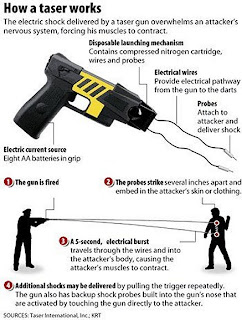
SCOTLAND YARD is to deploy officers armed with 50,000-volt Taser stun guns to deal
with violent demonstrators planning to disrupt this week’s G20 summit in London.
The centrepiece of the security plan will be hundreds of officers from the Metropolitan police territorial support group, who are routinely armed with speedcuffs, extended batons and CS gas spray.
The Met confirmed yesterday that they will be supported by officers equipped with Tasers on stand-by should trouble break out.
“There will be an armed response vehicle element to this operation and [those officers] will be carrying Tasers,” said a spokeswoman.
The Met’s admission that Tasers could be used for the first time in the UK during riots came as protest groups claimed police had contacted them to warn that a day of protest in the City on Wednesday would be “very violent”.
All police leave has been cancelled and 10,500 officers, including reinforcements from other forces, will be deployed in the biggest policing operation undertaken in London.
Demonstrations intended to bring the capital’s financial centre to a standstill on Wednesday and disruption to the G20 summit at the ExCel centre in Docklands on Thursday will provide the first big test for Sir Paul Stephenson, the new Met commissioner. He will be aware that the protests provide an opportunity to show the world that London is up to the security and public order challenges of the 2012 Olympics.
With yesterday’s TUC march, a state visit from the president of Mexico tomorrow and the arrival of 40 delegations including 19 heads of state for the G20 summit on Thursday, the week presents a series of complex operational challenges the like of which the Met has not seen in recent history. The organisers of the protests – an alliance of envi-ronmental campaigners, anticapitalist and religious groups – insist they will be peaceful. However, police fear that anarchist elements are likely to stir up trouble.
Police expect up to 1,500 protesters to converge on the Bank of England on Wednesday. At 12.30pm, other demonstrators are expected to “swoop” on the European Climate Exchange centre in Bishopsgate, where they plan to erect pop-up tents, makeshift toilets and even a bicycle-powered cinema, marking the start of a 24-hour Climate Camp.
WHO’S DEMONSTRATINGLondon Anarchists: have appealed for people to join in “direct action” similar to
that seen at previous antiglobalisation protests
Whitechapel Anarchists: London group which praised the attack on the home of Sir Fred
Goodwin, the disgraced bank boss
Class War: veteran anarchists who are encouraging supporters to “burn a banker”
G20 Meltdown: A new organisation which will host a carnival at the Bank of England
Climate Camp: environmentalists behind direct action at Heathrow airport and power
stations in North Yorkshire and Kent
Climate Rush: group against airport expansion who have “rushed” parliament
People and Planet: student network campaigning to end world poverty, defend human
rights and protect the environment
Stop the War Coalition and CND: anti-war protesters against Iraq and Afghanistan wars
Labels: G20, protesters, Tasers
London: We Wldn't Pay For Their Crisis!

Furious protesters took to the streets, voicing out a shared international displeasure at the bankers who have failed thoroughly. "WE WON'T PAY FOR THEIR CRISIS!!"
$$$$$$$$$$$$$$$$$$$$$$
Tens of thousands marched for five hours in "one of the largest" protests in London on Saturday, four days before the G20 summit kicks off.
Leaders from the world's 20 biggest economies are scheduled to meet in London on April 2 to discuss how tighter regulation of financial markets, billions of dollars in stimulus measures and credit lines for international trade can help the world economy recover.
The police, who are coordinating a large-scale security operation in the build-up to the summit, have been barred from going on leave until the summit ends.
"It's fair to say that this {protest} is one of the largest, one of the most challenging and one of the most complicated operations we have delivered," Commander Simon O'Brien, one of the officers in charge of security, said of Saturday's protest.
While the protest from Temple Place to Hyde Park highlighted several issues, including social inequality, loss of jobs, war and climate change, most took to the street to express their anger over bankers whose greed they say led to the global financial crisis.
The protesters, ranging from union members, taxi drivers and the retired, marched the 7.2-km stretch to the sound of brass bands, piercing whistles and blasting music from stereos. Among them was 73-year-old Geoff Stratford who awoke at 4:30 am so he could arrive in London from Manchester in time for the rally.
"The cause (of the financial crisis) lies in casino capitalism and in the greed of bankers," Stratford told China Daily as he and his wife marched, holding aloft a banner.
"We want to get the view through to the leaders who are meeting to find consensus. We have pensions and are not affected much by the crisis but the leaders should correct their mistakes and make people suffer less," he said and added that he would join the marches scheduled for Wednesday and Thursday as well.
Essex resident Milton McKenzie said: "How can we have a situation where we have people out of work and the bankers just cream it off, helped by the government?"
Dressed in green sportswear, Andrea Porteous and her 10-year-old daughter Taylera raised chants of: "Put children first".
Unwilling to admit she had lost her job, the 40-something former office administrator said: "I finished my work days ago." Porteous conceded that she had sent her resume to several companies but failed to get a single job offer. "Some of my friends too have not got feedback after sending 20-30 job application letters."
A London taxi driver said he joined the protest because the financial downturn meant his daily fare had gone down by 20-30 percent. "I have to drive six days a week or a minimum of two extra hours every day," said John, who refused to give his full name. "I am urging the G20 leaders to find a way to punish those who brought about the crisis."
Labels: Bankers, G20, Jobs, London, Protest, We Wldn't Pay For Their Crisis
Europe, US split deepens before G20 finance talks
Who will remember the poor countries which the IFIs have pledged to help? They didn't when they could. Now they cannot even save themselves
$$$$$$$$$$$$$$$$$$$$
World finance chiefs prepared for a ministerial meeting of the G20 leading economies near London on Saturday that threatens to expose deep divisions over how to halt the raging economic crisis.
Just three weeks before a gathering of heads of state from the Group of 20, discord seems to outweigh lip service to coordination and a German-French drive to focus on cross-border rules for finance is further souring the air.
"We have agreed that Germany and France will send a common signal at this summit" on April 2, German Chancellor Angela Merkel said at a joint press conference with French President Nicolas Sarkozy in Berlin.
"The issue is not spending even more but to put in place a regulatory system to prevent the economic catastrophe that the world is experiencing from being repeated," Merkel said in a direct rebuttal to US calls for more spending.
There must be "regulation and transparency of financial markets," she said.
US President Barack Obama, who enacted a 787-billion-dollar stimulus bill last month, tried to bridge the gap on Wednesday, calling for a two-pronged G20 effort to fix the global economy: stimulus measures and regulatory reforms.
But after a meeting of eurozone finance ministers this week, their chairman Prime Minister Jean-Claude Juncker of Luxembourg rejected the US calls for more pump-priming by other G20 economies, declaring such proposals "do not suit us."
Juncker after conferring with Czech officials in Prague on Thursday again voiced opposition to any additional spending plan to combat the crisis.
"The European recovery programme represents a spending level of 3.4 to 4.0 percent of GDP," he said.
"Our public finances are beginning to suffer and we must take account of the effects these programmes will have in 2009 and 2010 before we undertake additional spending."
The US stimulus is substantially more than the 400 billion euros engaged by 27 EU countries. The two total economies are of comparable size, but the EU has not forged an integrated response.
US Treasury Secretary Timothy Geithner has also called for the International Monetary Fund's "New Arrangements to Borrow" credit programme to be boosted to 500 billion dollars -- far more than proposed by the Europeans.
For the whole of 2009, Britain is chairing meetings of the G20 -- a grouping of 19 developed and developing countries plus the European Union that includes China, Germany, Japan, Mexico, Turkey and the United States.
The main point of contention appears to be a push by the United States and Britain -- which have angled much of their rescue spending on boosting demand -- for some leading EU countries to do likewise.
The United States and Britain have included heavy demand-side measures, such as a cut in sales tax in Britain, because they stimulate activity quickly.
They argue broadly that some countries, principally Germany but also France, have focused unduly on increasing state spending on investment in industry and infrastructure and should now allocate extra funds to spark consumption.
However, leading countries in Europe face constraints on their big budget deficits, which are rising markedly above EU limits.
German officials have also begun to talk about "exit strategies" from the massive state spending and support programmes once the crisis begins to abate.
European Commission chief Jose Manuel Barroso on Thursday defended Europe's efforts to soften the blow of the global crisis.
"The social system of Europe is very different from the American one," he told a news conference in Brussels.
"We have, compared to the US, a very ambitious system of social safety nets, in terms of unemployment, in terms of public health and in many other areas.
"So when we talk about fiscal stimulus, it's not the same thing in the US and in Europe because the Americans usually think about discretionary additional fiscal stimulus," he said.
Finance ministers and central bankers from G20 economies, will begin arriving on Friday at a hotel in the small town of Horsham south of London where the meeting is to be held.
"Ministers will discuss medium-term regulatory frameworks, the need for improvements to the financial system and wider economic stimulus and speak out against protectionism," Investec Securities economist Philip Shaw said.
Labels: Crisis, Europe, G20, IFI, United States of America
All talk and no action at G20 meeting
As expected. The party's gotten bigger with no real solution.
$$$$$$$$$$$$$$$$$$$$$$$$$$$$$$$
THE weekend meeting of the Group of 20 (G20) did not yield any dramatic announcements or proposals to overcome the financial crisis. The verdict on the outcome was mixed. The outgoing Bush administration saw progress, others said the leaders avoided the thornier issues, yet others opined that the G20 reshaped global politics, while the London- based Economist declared that it was "not a bad weekend's work". But if anyone expected the leaders to come out with concrete initiatives for a quick fix to the global economic woes, they would have been seriously disappointed.
The nations, accounting for 85 per cent of global economy, produced no real road map or major details on solving the meltdown.
The G20, however, laid the blame for the problems that started with the subprime mortgage crisis in the United States last August on "policy makers, regulators and supervisors in some advanced countries (who) did not adequately appreciate and address the risk building up in financial markets".
The contagion has spread. The US is in recession as is the euro zone. In Asia, Singapore and Japan are in recession, technical or otherwise.
Much of the wealth created over decades, including in developing countries, has been destroyed by the meltdown, while major institutions and household names have been brought to their knees.
To be sure, no one expected the lame-duck US President George W. Bush, who chaired the meeting, to produce a sliver bullet to solve the problems that are rapidly spreading around the world.
It would be asking too much of the G20 leaders to resolve the financial problems in one day. Undoubtedly, they came to the table with their own expectations.
In the end, they issued a bland statement.
Many of the measures they outlined are being worked on or have been implemented by individual countries to tackle the crisis at home. What is needed is a global, coordinated approach to solving the crisis.
The leaders promised a "broader policy response" and to strive for a deal on the stalled Doha Round of trade talks by the end of the year. They also pledged not to raise any barriers to trade and investment.
But this is nothing new. The previous pledges on the stalled Doha Development Round have not been fulfilled and with the current meltdown in the global economy, trade takes a back seat to rescuing companies, bailing out banks and ensuring that sovereign nations do not go under.
The markets, fund managers, analysts and indeed the poorest of the poor were hoping for an immediate and powerful signal that would throw some light on the way forward out of the dark tunnel. There were no new measures or regulatory breakthroughs. But what they got was a promise of more meetings.
The leaders set out a work schedule for their finance ministers: a review of global accounting standards, colleges of supervisors for major global banks, new standards for credit rating agencies and ways to limit bankers' pay by tying it to companies' risk profiles.
The ministers are to complete their job by the end of March for another meeting of the leaders in April.
By then, Barack Obama will be the president of the US and the Czech Republic will hold the rotating European Union presidency, taking over from Nicolas Sarkozy of France.
The difference of this meeting is that for the first time some emerging and developing economies as well as some oil producers got a seat at the table.
The rapidly-declining state of the US and European economies and victors of World War 2 find themselves in a weakened economic and financial position.
British Prime Minister Gordon Brown had lobbied Saudi Arabia and China to provide financial assistance to the Bretton Woods institutions.
The number of countries, including developed nations such as Iceland, going with bowl in hand to the multilateral institutions is putting greater pressure on the limited finances of the World Bank and the International Monetary Fund (IMF).
Indeed, the developed nations and their institutions are no longer the lenders of first and last resort.
They, in fact, are the borrowers and the lenders are the emerging economies and their sovereign wealth funds. There has been a clear shift away from dependence on Wall Street's financial supremacy and from the theories and remedies advocated by the World Bank and IMF.
The economic power has shifted from the Group of 7 (G7) most industrialised nations to a much larger and more diversified group of countries, including Asian nations.
According to Indian Finance Minister Palaniappan Chidambaram: "The G7 has recognised belatedly that they alone don't have the solutions to all the problems.
"The G20 has come to stay as the single most important forum to address the financial and economic issues of the world. The G20 is a much better forum than the G7."
He described the Washington summit as "a good beginning", adding: "The emerging economies are happy."
The shift in economic and financial power cannot be ignored as leaders seek solutions to the crisis and develop a new financial architecture.
The developing countries may have been given a seat at the table but their long-term role in the global economy and in decision-making must be considered.
For a start, the G20 agreed to a seat for emerging market economies on the Financial Stability Forum, the group of financial regulators and central bankers charged with the technicalities of financial supervision, whose membership has been based on that of the G7.
In the medium term, developing countries will be offered more seats at the IMF and World Bank.
Even so, it must be remembered that talk of reforming the IMF has gone on for years without much headway being made. The devil is in the details.
In the end, many saw the meeting more of talk than action.
"This is plain-vanilla stuff they could have agreed on without holding a meeting," said Simon Johnson, an economist at the Massachusetts Institute of Technology and a former chief economist of the IMF. "What's new, except that this is the G20 instead of the G7?"
Labels: Emerging Economies, G20, G7, IMF, World Bank
G20: Global Summit to Reform IFIs
Source: Infoshop
Over the summer of 2008 pressure was already building in official circles for a new Bretton Woods-style international conference to restructure the international financial architecture. A Commonwealth summit in June produced a statement calling for such a conference. And the discussions on the draft document for the UN's Financing for Development conference in Doha (slated for December 20008) also have included language calling for such a conference. Finally in early October, the calls were made publicly by leaders of several big European countries, notably France. This may be the greatest chance since 1944 to influence the structure of international finance. This page is aimed at helping civil society coordinate a response to this potential conference. We will bring you analysis, links to documents and highlight selected events. If you want to contribute just write to info@brettonwoodsproject.org.
Intelligence and responses towards a so-called "Bretton Woods 2"
Over the summer of 2008 pressure was already building in official circles for a new Bretton Woods-style international conference to restructure the international financial architecture. A Commonwealth summit in June produced a statement calling for such a conference. And the discussions on the draft document for the UN's Financing for Development conference in Doha (slated for December 20008) also have included language calling for such a conference. Finally in early October, the calls were made publicly by leaders of several big European countries, notably France. This may be the greatest chance since 1944 to influence the structure of international finance. This page is aimed at helping civil society coordinate a response to this potential conference. We will bring you analysis, links to documents and highlight selected events. If you want to contribute just write to info@brettonwoodsproject.org.
Civil society moves
The IFI watching and debt activist communities and movements are working on a global sign-on letter to governments about the process for a new international financial architecture. Please check back here for more information on this effort shortly.
Several NGO networks and movements have produced statements on the financial crisis and their demands for a reformed international financial architecture. These statements generally focus on the financial sector and financial markets. But it is expected that more will be forthcoming. If you have a statement you want included in this list please let us know (info@brettonwoodsproject.org).
Latest intelligence
After the calls from three major European leaders (UK, France, and Germany) for a new international financial architecture, the G7 was pressured into acting. US president George Bush has agreed to host a summit in the US in the second week of November. The G8 statement calls for "key leaders" to be invited but makes it clear that it will not be a truly international summit. French president Nicholas Sarkozy was with George Bush in Washington for the announcement. Gordon Brown, UK prime minister, seems to have agreed as well on the timetable for a quick conference in November with only selected participation. If you have more intelligence you would like to share please do make it available. Bush has now set the date for the summit as 15 November, and plans to host it in Wahsington, spurning the offer from the UN general secretary to hold the conference at UN headquarters in New York. The plan is to invite the members of the G20 which means the G8 plus some emerging markets (like Brazil, India, China, Argentina, Turkey, South Africa, and Indonesia) and other rich OECD countries (like Australia and South Korea), as well as Saudi Arabia.
In contrast to the G8 moves, the president of the UN General Assembly announced he is setting up a high-level task force to review the global financial system, including major bodies such as the World Bank and the International Monetary Fund (IMF), in response to the current turmoil that is affecting all countries, large and small. Miguel D'Escoto has appointed Joseph Stiglitz to chair the panel, which will also suggest steps to be taken by UN members "to secure a more stable global economic order". The special commission is to hold its first meeting on 30 October.
Background
For more background on the calls for the new conference the best paper is the briefing produced by our colleagues in Canada at the Halifax Initiative. Their issue brief, Rethinking the international financial system and its architecture: Calls for a "Bretton Woods II" walks people through the calls that have been made up until mid October 2008. As of now the following people/forums have announced support for such an initiative.
- Selected Commonwealth heads of state in the Marlborough House statement
- Nicholas Sarkozy, president of France
- Gordon Brown, UK prime minister
- Angela Merkel, German chancellor
- Commonwealth finance ministers in their October 8 statement
- Ban Ki-Moon, Secretary General of the United Nations
- Supachai Panitchpakdi, UNCTAD Secretary-General
- UN Financing for Development (draft outcome document)
Additionally some governments and statements have expressed interest in something less comprehensive than a full international conference involving all countries and external stakeholders. For example:
- The G8 statement of October 15 calls for a meeting of "key leaders"
- Pascal Lamy, director-general of the WTO "welcome[d] the construction of what some are calling a new Bretton Woods consensus" according to Livemint/WSJ
Labels: Bretton Woods, G20
G20: Global Summit to Reform IFIs
Source: Infoshop

Over the summer of 2008 pressure was already building in official circles for a new Bretton Woods-style international conference to restructure the international financial architecture. A Commonwealth summit in June produced a statement calling for such a conference. And the discussions on the draft document for the UN's Financing for Development conference in Doha (slated for December 20008) also have included language calling for such a conference. Finally in early October, the calls were made publicly by leaders of several big European countries, notably France. This may be the greatest chance since 1944 to influence the structure of international finance. This page is aimed at helping civil society coordinate a response to this potential conference. We will bring you analysis, links to documents and highlight selected events. If you want to contribute just write to info@brettonwoodsproject.org.
Intelligence and responses towards a so-called "Bretton Woods 2"
Over the summer of 2008 pressure was already building in official circles for a new Bretton Woods-style international conference to restructure the international financial architecture. A Commonwealth summit in June produced a statement calling for such a conference. And the discussions on the draft document for the UN's Financing for Development conference in Doha (slated for December 20008) also have included language calling for such a conference. Finally in early October, the calls were made publicly by leaders of several big European countries, notably France. This may be the greatest chance since 1944 to influence the structure of international finance. This page is aimed at helping civil society coordinate a response to this potential conference. We will bring you analysis, links to documents and highlight selected events. If you want to contribute just write to info@brettonwoodsproject.org.
Civil society moves
The IFI watching and debt activist communities and movements are working on a global sign-on letter to governments about the process for a new international financial architecture. Please check back here for more information on this effort shortly.
Several NGO networks and movements have produced statements on the financial crisis and their demands for a reformed international financial architecture. These statements generally focus on the financial sector and financial markets. But it is expected that more will be forthcoming. If you have a statement you want included in this list please let us know (info@brettonwoodsproject.org).
Latest intelligence
After the calls from three major European leaders (UK, France, and Germany) for a new international financial architecture, the G7 was pressured into acting. US president George Bush has agreed to host a summit in the US in the second week of November. The G8 statement calls for "key leaders" to be invited but makes it clear that it will not be a truly international summit. French president Nicholas Sarkozy was with George Bush in Washington for the announcement. Gordon Brown, UK prime minister, seems to have agreed as well on the timetable for a quick conference in November with only selected participation. If you have more intelligence you would like to share please do make it available. Bush has now set the date for the summit as 15 November, and plans to host it in Wahsington, spurning the offer from the UN general secretary to hold the conference at UN headquarters in New York. The plan is to invite the members of the G20 which means the G8 plus some emerging markets (like Brazil, India, China, Argentina, Turkey, South Africa, and Indonesia) and other rich OECD countries (like Australia and South Korea), as well as Saudi Arabia.
In contrast to the G8 moves, the president of the UN General Assembly announced he is setting up a high-level task force to review the global financial system, including major bodies such as the World Bank and the International Monetary Fund (IMF), in response to the current turmoil that is affecting all countries, large and small. Miguel D'Escoto has appointed Joseph Stiglitz to chair the panel, which will also suggest steps to be taken by UN members "to secure a more stable global economic order". The special commission is to hold its first meeting on 30 October.
Background
For more background on the calls for the new conference the best paper is the briefing produced by our colleagues in Canada at the Halifax Initiative. Their issue brief, Rethinking the international financial system and its architecture: Calls for a "Bretton Woods II" walks people through the calls that have been made up until mid October 2008. As of now the following people/forums have announced support for such an initiative.
- Selected Commonwealth heads of state in the Marlborough House statement
- Nicholas Sarkozy, president of France
- Gordon Brown, UK prime minister
- Angela Merkel, German chancellor
- Commonwealth finance ministers in their October 8 statement
- Ban Ki-Moon, Secretary General of the United Nations
- Supachai Panitchpakdi, UNCTAD Secretary-General
- UN Financing for Development (draft outcome document)
Additionally some governments and statements have expressed interest in something less comprehensive than a full international conference involving all countries and external stakeholders. For example:
- The G8 statement of October 15 calls for a meeting of "key leaders"
- Pascal Lamy, director-general of the WTO "welcome[d] the construction of what some are calling a new Bretton Woods consensus" according to Livemint/WSJ
Labels: Bretton Woods 2, G20