Are the Police Protesting Too Much?

A man lost his life yesterday. PUT PEOPLE FIRST!!!! Those of you in London, do keep lending your voice and keep safe.
$$$$$$$$$$$$$$$$$$$$$$$$
The trouble-makers are out in force again. Dressed in black, their faces partly obscured, some of them appear to be interested only in violent confrontation. It's almost as if they are deliberately raising the temperature, pushing and pushing until a fight kicks off. But this isn't some disorganised rabble: these people were bussed in and are plainly acting in concert. There's another dead giveaway. They are all wearing the same slogan: Police.
The police have been talking up violence at the G20 protests for weeks. They briefed journalists and companies in the City of London about the evil designs of the climate campaigners intending to demonstrate there, but refused to let the campaigners attend the briefings and put their own side of the story. They also rebuffed the campaigners when they sought to explain to the police what they wanted to do.
The way officers tooled themselves up in riot gear and waded into a peaceful crowd this afternoon makes it look almost as if they were trying to ensure that their predictions came true. Their bosses appear to have failed either to read or to heed the report by the parliamentary committee on human rights last week, about the misuse of police powers against protesters. "Whilst we recognise police officers should not be placed at risk of serious injury," the report said, "the deployment of riot police can unnecessarily raise the temperature at protests."
But there has always been a conflict of interest inherent in policing. The police are supposed to prevent crime and keep the streets safe. But if they are too successful, they do themselves out of a job. They have a powerful interest in exaggerating threats and, perhaps, an interest in ensuring that sometimes these threats materialise. This could explain what I've seen at one protest after another, where peaceful demonstrations turn into ugly rucks only when the police attack. The wildly disproportionate and unnecessary violence I've sometimes seen the police deploy could scarcely be better designed to provoke a reaction.
If this is so, they lose nothing. They might get the occasional rap over the knuckles from MPs or the police complaints commission. It doesn't seem to bother them. By planting the idea in the public mind that the streets could erupt into catastrophic violence at any time, were it not for the thick blue line thrown around even the mildest protest, they establish the need for a heavy police presence. While the public lives in fear, no government dares to cut the policing budget.
Labels: 2009, Brutatliy, Death, G20, Police, protesters
G20 protesters face police with Tasers
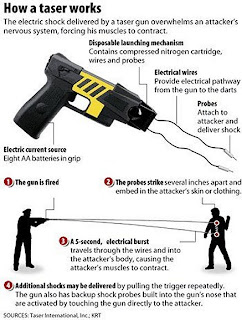
SCOTLAND YARD is to deploy officers armed with 50,000-volt Taser stun guns to deal
with violent demonstrators planning to disrupt this week’s G20 summit in London.
The centrepiece of the security plan will be hundreds of officers from the Metropolitan police territorial support group, who are routinely armed with speedcuffs, extended batons and CS gas spray.
The Met confirmed yesterday that they will be supported by officers equipped with Tasers on stand-by should trouble break out.
“There will be an armed response vehicle element to this operation and [those officers] will be carrying Tasers,” said a spokeswoman.
The Met’s admission that Tasers could be used for the first time in the UK during riots came as protest groups claimed police had contacted them to warn that a day of protest in the City on Wednesday would be “very violent”.
All police leave has been cancelled and 10,500 officers, including reinforcements from other forces, will be deployed in the biggest policing operation undertaken in London.
Demonstrations intended to bring the capital’s financial centre to a standstill on Wednesday and disruption to the G20 summit at the ExCel centre in Docklands on Thursday will provide the first big test for Sir Paul Stephenson, the new Met commissioner. He will be aware that the protests provide an opportunity to show the world that London is up to the security and public order challenges of the 2012 Olympics.
With yesterday’s TUC march, a state visit from the president of Mexico tomorrow and the arrival of 40 delegations including 19 heads of state for the G20 summit on Thursday, the week presents a series of complex operational challenges the like of which the Met has not seen in recent history. The organisers of the protests – an alliance of envi-ronmental campaigners, anticapitalist and religious groups – insist they will be peaceful. However, police fear that anarchist elements are likely to stir up trouble.
Police expect up to 1,500 protesters to converge on the Bank of England on Wednesday. At 12.30pm, other demonstrators are expected to “swoop” on the European Climate Exchange centre in Bishopsgate, where they plan to erect pop-up tents, makeshift toilets and even a bicycle-powered cinema, marking the start of a 24-hour Climate Camp.
WHO’S DEMONSTRATINGLondon Anarchists: have appealed for people to join in “direct action” similar to
that seen at previous antiglobalisation protests
Whitechapel Anarchists: London group which praised the attack on the home of Sir Fred
Goodwin, the disgraced bank boss
Class War: veteran anarchists who are encouraging supporters to “burn a banker”
G20 Meltdown: A new organisation which will host a carnival at the Bank of England
Climate Camp: environmentalists behind direct action at Heathrow airport and power
stations in North Yorkshire and Kent
Climate Rush: group against airport expansion who have “rushed” parliament
People and Planet: student network campaigning to end world poverty, defend human
rights and protect the environment
Stop the War Coalition and CND: anti-war protesters against Iraq and Afghanistan wars
Labels: G20, protesters, Tasers