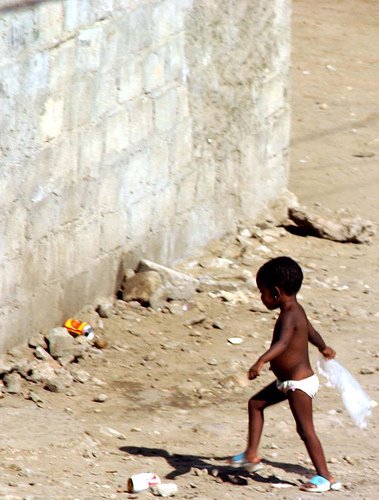
All talk and no action at G20 meeting
As expected. The party's gotten bigger with no real solution.
$$$$$$$$$$$$$$$$$$$$$$$$$$$$$$$
THE weekend meeting of the Group of 20 (G20) did not yield any dramatic announcements or proposals to overcome the financial crisis. The verdict on the outcome was mixed. The outgoing Bush administration saw progress, others said the leaders avoided the thornier issues, yet others opined that the G20 reshaped global politics, while the London- based Economist declared that it was "not a bad weekend's work". But if anyone expected the leaders to come out with concrete initiatives for a quick fix to the global economic woes, they would have been seriously disappointed.
The nations, accounting for 85 per cent of global economy, produced no real road map or major details on solving the meltdown.
The G20, however, laid the blame for the problems that started with the subprime mortgage crisis in the United States last August on "policy makers, regulators and supervisors in some advanced countries (who) did not adequately appreciate and address the risk building up in financial markets".
The contagion has spread. The US is in recession as is the euro zone. In Asia, Singapore and Japan are in recession, technical or otherwise.
Much of the wealth created over decades, including in developing countries, has been destroyed by the meltdown, while major institutions and household names have been brought to their knees.
To be sure, no one expected the lame-duck US President George W. Bush, who chaired the meeting, to produce a sliver bullet to solve the problems that are rapidly spreading around the world.
It would be asking too much of the G20 leaders to resolve the financial problems in one day. Undoubtedly, they came to the table with their own expectations.
In the end, they issued a bland statement.
Many of the measures they outlined are being worked on or have been implemented by individual countries to tackle the crisis at home. What is needed is a global, coordinated approach to solving the crisis.
The leaders promised a "broader policy response" and to strive for a deal on the stalled Doha Round of trade talks by the end of the year. They also pledged not to raise any barriers to trade and investment.
But this is nothing new. The previous pledges on the stalled Doha Development Round have not been fulfilled and with the current meltdown in the global economy, trade takes a back seat to rescuing companies, bailing out banks and ensuring that sovereign nations do not go under.
The markets, fund managers, analysts and indeed the poorest of the poor were hoping for an immediate and powerful signal that would throw some light on the way forward out of the dark tunnel. There were no new measures or regulatory breakthroughs. But what they got was a promise of more meetings.
The leaders set out a work schedule for their finance ministers: a review of global accounting standards, colleges of supervisors for major global banks, new standards for credit rating agencies and ways to limit bankers' pay by tying it to companies' risk profiles.
The ministers are to complete their job by the end of March for another meeting of the leaders in April.
By then, Barack Obama will be the president of the US and the Czech Republic will hold the rotating European Union presidency, taking over from Nicolas Sarkozy of France.
The difference of this meeting is that for the first time some emerging and developing economies as well as some oil producers got a seat at the table.
The rapidly-declining state of the US and European economies and victors of World War 2 find themselves in a weakened economic and financial position.
British Prime Minister Gordon Brown had lobbied Saudi Arabia and China to provide financial assistance to the Bretton Woods institutions.
The number of countries, including developed nations such as Iceland, going with bowl in hand to the multilateral institutions is putting greater pressure on the limited finances of the World Bank and the International Monetary Fund (IMF).
Indeed, the developed nations and their institutions are no longer the lenders of first and last resort.
They, in fact, are the borrowers and the lenders are the emerging economies and their sovereign wealth funds. There has been a clear shift away from dependence on Wall Street's financial supremacy and from the theories and remedies advocated by the World Bank and IMF.
The economic power has shifted from the Group of 7 (G7) most industrialised nations to a much larger and more diversified group of countries, including Asian nations.
According to Indian Finance Minister Palaniappan Chidambaram: "The G7 has recognised belatedly that they alone don't have the solutions to all the problems.
"The G20 has come to stay as the single most important forum to address the financial and economic issues of the world. The G20 is a much better forum than the G7."
He described the Washington summit as "a good beginning", adding: "The emerging economies are happy."
The shift in economic and financial power cannot be ignored as leaders seek solutions to the crisis and develop a new financial architecture.
The developing countries may have been given a seat at the table but their long-term role in the global economy and in decision-making must be considered.
For a start, the G20 agreed to a seat for emerging market economies on the Financial Stability Forum, the group of financial regulators and central bankers charged with the technicalities of financial supervision, whose membership has been based on that of the G7.
In the medium term, developing countries will be offered more seats at the IMF and World Bank.
Even so, it must be remembered that talk of reforming the IMF has gone on for years without much headway being made. The devil is in the details.
In the end, many saw the meeting more of talk than action.
"This is plain-vanilla stuff they could have agreed on without holding a meeting," said Simon Johnson, an economist at the Massachusetts Institute of Technology and a former chief economist of the IMF. "What's new, except that this is the G20 instead of the G7?"
Labels: Emerging Economies, G20, G7, IMF, World Bank
Banks, Firms, Now Countries Falter
We can always be sure that when the US sinks, they drag the whole world down with them.
What would Obama do?
$$$$$$$$$$$$$$$$$$$$$$$$
Source:
The ScotsmanMORE countries may be forced to seek unprecedented help from the International Monetary Fund, experts warned last night, after another day of turmoil on world markets.
Hungary has followed Iceland and Ukraine in securing funding from the IMF to prevent complete financial meltdown. Pakistan and Belarus are in talks with the IMF, while glaring holes in a number of other countries' economies have led to predictions that more begging bowls may soon come out.
Experts told The Scotsman countries such as Ireland, which has guaranteed all its bank deposits, could find themselves in need of international help.
Government bail-outs of financial institutions have become almost commonplace – and now countries themselves are having to be saved.
The latest IMF guarantees came on a day of extreme volatility on world stock markets, with billions wiped off shares in leading firms and the pound sinking to a five-year low against the dollar.
In a bid to soothe the chaos, the G7 nations issued a statement pledging co-operation in the crisis. Britain, Canada, France, Germany, Italy, Japan and the United States reaffirmed their "shared interest in a strong and stable international financial system".
At the same time, they voiced concern about "excessive volatility" in the value of the Japanese yen, which on Friday hit a 13-year high against the dollar.
The yo-yoing world currencies make trading sluggish, as it is impossible to ascertain how much deals are worth.
"There's lots of volatility, not just in the equity market, but in the interest rate and currency markets too," Neil Parker, market strategist at Royal Bank of Scotland, said. "We're going to get further big swings as the markets watch for what the authorities are going to do."
On Friday, the IMF bailed out Iceland – whose swift collapse has devastated UK pension funds and investments – to the tune of £1.34 billion. Yesterday, however, Geir Haarde, its prime minister, said Iceland needed double that again.
He spoke as the fund agreed to lend to Hungary and Ukraine.
It is to offer a £10.4 billion loan to Ukraine and has agreed an as-yet undisclosed package with Hungary. David Hauner, an analyst at Bank of America, said it would probably receive about $12.5 billion (£8 billion).
Eastern Europe has suffered greatly from the global financial crisis as foreign investors who were once bullish about the region's prospects of strong economic growth and deeper integration into the European Union have dumped their assets.
In particular, there is concern that countries such as Ukraine and EU members Hungary, Romania, Bulgaria and the Baltic states may not be able to handle their large foreign debt burdens. Standard & Poor's rating agency yesterday reduced Romania's sovereign rating to junk status.
Neil Shearing, an economist at Capital Economics, said "the most vulnerable countries in the region have yet to be hit by the crisis". He added: "Accordingly, it seems that the IMF's work has only just begun."
Professor Gabriel Talmain, director of the Centre for Economic and Financial Studies at Glasgow University, said: "Countries have taken a very big gamble when they started to guarantee the banks. If the Irish government was to be called on to honour all the guarantees that it has put up for its banks, God knows what will happen. They would be the next (to seek an IMF loan]."
The Washington-based institution has said it can provide up to £128 billion in loans to countries facing financial difficulties.
Prof Talmain said European countries were not in the habit of going to the IMF for cash and warned the fund's members would probably have to cover for loans that could not be paid back.
Meanwhile, investors endured a rollercoaster ride yesterday, as London's leading share index pulled back from five-year lows. The FTSE 100 Index plunged to its lowest point since March 2003 at one point, falling 5 per cent as a sell-off in Asian markets spooked jittery traders. Japan's Nikkei index fell 6.4 per cent to reach its lowest close since 1982, while Hong Kong's Hang Seng closed 13 per cent down.
But a better-than-expected start on Wall Street and a broad hint from the head of the European Central Bank of more interest rate cuts next week helped the top-flight claw back most of the losses.
Among the shares hit in London were those of the leading banks, which have been swinging wildly for weeks. RBS, which is preparing for a big government cash injection, fell 5.92 per cent to only 57.2p a share. And HSBC, which had been flying high above other institutions, tumbled 4.74 per cent to £6.63.
Meanwhile, HBOS and Lloyds TSB were both up marginally, while Barclays dropped slightly.
Brown's famous 'golden rule' becomes early victim of Britain's slide into recessionALISTAIR Darling, the Chancellor, is expected to consign the government's main economic rules to history tomorrow, as a result of having to borrow vast sums to keep the country afloat during the recession.
He is expected to use a set-piece speech to indicate that the "golden rule" – imposed by Gordon Brown in 1997 to win New Labour credibility in the City – has been abandoned.
The rule prevents the Treasury from using public borrowing to fund current spending, such as wages or tax cuts, over the economic cycle. It permits borrowing only for investment in major capital projects, such as schools and hospitals.
But with UK borrowing already at £37.6 billion for the first half of this financial year, experts believe the final sum will be £64 billion – compared with Mr Darling's target of £43 billion.
Mr Brown yesterday said he was prepared to allow borrowing to rise as it was the "responsible" thing to do.
The second rule he introduced as Chancellor, the sustainable investment rule, has also been broken. This requires national debt to be kept below 40 per cent of the value of the economy over the economic cycle, but the Office for National Statistics said last week it was already at 43.4 per cent.
Mr Brown, in a speech in London, departed from a prepared script that said a "temporary increase in borrowing is the right thing to do to support the economy at this time". Instead, it was only when he was answering questions from the audience, that he mentioned "borrowing" – saying that amounts would come down when the economy picked up and tax revenues increased.
Meanwhile, incapacity benefit was scrapped for new claimants under a drive to get a million more people into work by 2015. People now face a 13-week check – including a 75-minute interview – to assess what tasks they can carry out. Only those with the severest conditions will receive benefits.
Q&A
What is the International Monetary Fund?It is an organisation of 185 member countries that was established to promote monetary co-operation, foster economic growth and high levels of employment, and provide temporary financial assistance to countries.
Does it have infinite funds?It doesn't really have much of its own resources – it has to borrow.
How does it lend money?It has to get the approval of its board, which is made up of representatives from its 185 member states.
Where does it get the cash from?It goes to the wholesale money markets, like any individual government or institution.
Are there any risks to its member states?With these large sums it is now lending – potentially. Professor Gabriel Talmain, director of the centre for economic and financial studies at Glasgow University, said: "If it starts to borrow really large amounts of money, there would be the question of how much the other member countries behind the IMF will pay as a last resort."
He said the current loans were "staggering" and there was only a finite amount of funds available.
What is the advantage of going to the IMF for funds?It's a collective institution, so one government is not relying directly on another. Such a situation would be undesirable for two reasons – it could allow for political pressure to be exerted and it would not provide as much funding.
Why are countries going to the IMF now?Eastern Europe has run into trouble because investors believe it may not be able to cope with the foreign debt it has amassed.
What about Pakistan?The rupee has fallen drastically against the dollar. The country is struggling to combat inflation, which is heading towards 30 per cent, and a collapsing currency. Its central bank, meanwhile, holds barely enough foreign currency to cover five weeks of imports.
Are the loans free from conditions?Certainly not. The conditions can be quite stringent and, for the Eastern European states, they may signal the start of a new era of austerity. But it is Pakistan for which they are a real sticking point, with local analysts accusing the United States of using the IMF as a tool in its war against terror.
Labels: Crisis, G7, IMF, Loan
IMF and G-7 Say: No More Lehmans
If the financial giants cannot take care of businesses at home, what makes them think that they are capable of giving aid at an international level?
$$$$$$$$$$$$$$$$$$$$$$$$$$$$$
Now the great confidence game begins. In high-powered forums that accompanied the G-7 and International Monetary Fund in Washington this past weekend, Western financial leaders sought to assure panicky bankers and money managers in no uncertain terms that all of the measures needed to halt a worldwide meltdown are in motion.
While short on the details many market analysts had hoped for, the broad brushstrokes of forceful, coordinated action by Western governments were unveiled: No more Lehman Brothers-like failures of major financial institutions will be allowed. All bank deposits will be guaranteed. The banking systems of the G-7 nations will be flooded with almost unlimited liquidity. And if all that fails, any other tool—regardless of how economically unorthodox—will be used if needed. The British government's widely anticipated move to take majority control of the Royal Bank of Scotland Group and HBOS is expected to be the first of many such actions across Europe. Fifteen European Union countries that use the euro as currency met in Paris this weekend. They pledged to provide guarantees of new bank debt through 2009, authorize the purchase of preferred shares to invest in problematic banks, and provide recapitalization funds where needed.
The message of Banque de France Deputy Governor Jean-Piere Landau at an Oct. 12 breakfast meeting at Washington's elegant Willard Intercontinental Hotel was typical. "I think the conditions for stability are met," Landau declared. "It is very difficult to see why there will be no stabilization." At a nearby hotel, Richard Fisher, president of Dallas Federal Reserve, told a crowd of international bankers that U.S. authorities "can and will restore order in the credit markets" and "will continue to pursue every avenue and every option." At a press conference at the International Monetary Fund's headquarters, IMF Managing Director Dominique Strauss-Kahn said: "I believe we have an adequate response to the crisis, and the market will reflect it."
Spillover WorldwideWhen the markets open on Monday morning, it will be clear whether these verbal assurances and whatever specific measures the U.S. and individual European nations announce will be enough to ease the credit freeze and halt the stock sell-off. But even if the markets breathe a sigh of relief, the question is, how long will the calm last?
Even assuming that actions by the U.S. and Euroland are enough to get the credit markets moving again, attention is likely to shift to fathoming what lies ahead. The economic picture is dark, not only in the U.S. and Europe but also in key emerging markets that not long ago were regarded as bright spots. "As the markets move away from financial fears, they will start looking at what the spillovers will be to the real economy," says Deutsche Bank Group (DB) Chief Economist Norbert Walter.
In business forums and cocktail parties, financiers gathered in Washington mulled long-term implications that few had thought possible not long ago. What makes this financial crisis so different from many of the others faced in the past three decades is that it did not originate with peripheral emerging markets. It struck the core of global capitalism. And unlike previous U.S. recessions, this crisis cannot be fixed with changes in monetary and fiscal policy. It will require years of financial workouts and restructuring. The fallout, therefore, is likely to radiate out across the globe in countless unforeseen ways.
Long, Slow RecoveryOne point of consensus is that the U.S. is heading into a very deep recession, perhaps the worst in the post-World War II era. The Institute of International Finance, which just months ago predicted the U.S. would not go into recession, now sees a contraction of at least 2% for several quarters and the jobless rate hitting 7%. And that estimate is based on the premise that the Treasury and Fed rescue efforts will work.
Don't expect the U.S. economy to roar back once recovery begins, either. Fully rebuilding the U.S. credit system and confidence will take time. JP Morgan Chase (JPM) chief economist Bruce Kasman warned that it is far too early to gauge the long-term impact on U.S. consumer behavior. In Japan, consumers held onto their cash for years, which helped delay recovery for a decade.
And don't expect emerging markets to be able to pull the global economy through. Despite falling exports, China's economy is expected to remain robust, thanks to $1.8 trillion in foreign reserves and strong domestic demand. But elsewhere a collapse in demand in the U.S. and Europe will dramatically change the dynamics even in many nations that a few months ago appeared to be in solid shape due to strong trade surpluses and foreign reserves. Emerging markets are going to be hit hard by a triple whammy: plunging manufacturing exports to the U.S., falling commodity prices, and outflows of dollars.
Plunging OilLet's start with foreign capital flows: Even though most developing-nation governments have dramatically slashed their dependence on foreign loans, their corporate sectors have been borrowing heavily abroad to finance everything from real estate developments to factories. In the past two months, Russia's foreign reserves have dropped by $40 billion because of capital flight. And several Persian Gulf states have had to tap into their huge sovereign wealth funds to prop up stocks and real estate projects funded by foreign capital. The IIF projects that inflows of foreign private capital to emerging markets, which hit a record $898 billion in 2007, will drop by at least $270 billion by the end of this year and contract further in 2009.
In addition, nations that depend heavily on oil and other commodities could soon be in for more trouble than they anticipated. Oil prices, for example, have already plunged from a peak of $145 a barrel this summer to near $70. That's still in the financial comfort zone of Russia, Venezuela, Iran, and other non-Mideast oil producers. But at the IIF conference, University of Calgary management professor David Mitchell, a leading authority on oil, laid out a scenario in which a sharp contraction in global demand could push crude all the way back down to $25 a barrel—a crisis level for all but Saudi Arabia and a few other Gulf nations.
The debt crash certainly will lead to a rethinking of America's financial system. But the seismic aftershocks will require revision of all assumptions about the global economy.
Labels: Economy, G7, Global, IMF, Lehman Brothers