Singapore Authorities Cast a Wary Eye on Civil Groups Ahead of APEC summit
Singapore, the scourge of human rights activists has done it again. The oppresive state hosts the coming Asia-Pacific Economic Cooperation which Obama is attending. Again, the authorities have taken measures to clamp down on civil groups and activists like what they did when they hosted the IMF / WB three years ago.
Even the Pittsburgh Citizen Police Review Board is reviewing the actions of policement during the G20 meetings. It is time for the Singapore government to stop supressing our voices. Then again, perhaps human rights is mostly dead in the Asia-Pacific region.
$$$$$$$$$$$$$$$$$$$$$$
With two weeks to go before heads of state gather for the Asia-Pacific Economic Cooperation (APEC) summit here, Singapore is wary about allowing the entry of well-organised civil groups and disruptive individuals bent on derailing the talks or championing their causes.
Two Falungong followers, a Malaysian and an Indonesian, were reportedly denied entry into Singapore at Changi Airport last week.
According to the Epoch Times, the sect's publication, the pair tried to enter the country separately on Oct 19 and Oct 22. The report also said the pair had previously made frequent trips to Singapore.
Falungong, a religious sect, was banned in China in 1999 after it was accused of fanning social unrest. Though it is not outlawed in Singapore, several of its followers here have been arrested for holding illegal assemblies.
When MediaCorp cited the Falungong example and asked if Singapore was keeping out individuals who might pose law-and-order problems, a spokeswoman from the APEC Singapore 2009 organising committee said all requests to enter the country would be treated fairly.
"All sovereign nations have the prerogative to decide who cross their borders. Singapore is no exception," she said. "This is especially so in the current security climate, where we have a duty to ensure the safety and security of the public."
Security analyst Dr John Harrison from the S. Rajaratnam School of International Studies was not surprised with the entry ban related to APEC.
"The (Singapore) Government will get a variety of information in from all sources - open and classified - from partners in the region and around the world," he said. "It will try and mitigate threats and risks as early as possible."
Apart from the task of keeping out people with backgrounds tied to terrorism, the authorities would have their eye on individuals who could use the event to carry out violent protests, Dr Harrison said.
Three years ago, when Singapore hosted the International Monetary Fund-World Bank meeting, the authorities objected to 28 foreigners - all of whom had a history of taking part in violent protests or disruptive activities at previous meetings - from being allowed into the country.
Then, civil society organisations were allowed to protest in a small corner of the meeting venue at Suntec Singapore International Convention and Exhibition Centre; large-scale protests were confined to the Indonesian island of Batam.
Observers say that unlike the IMF event to which many civil society groups were invited, APEC's broader platform is not likely to warrant the same level of involvement and, hence, numbers of activists.
Labels: Asia-Pacific Economic Cooperation, Batam, Civil Groups, Protest, Singapore
Singapore shoots down "rumor" of APEC attack plot
Singapore has downplayed media reports of a plot to attack an Asia-Pacific summit in the city-state in November, the Straits Times newspaper reported on Monday.
"The rumors are rumors. You check it, if it is unverifiable, you know you can't be chasing after every rumor,' Second Home Affairs Minister K. Shanmugam was quoted by the daily as saying during a mock terrorist attack exercise on Sunday.
The Singapore Police Force and the Ministry of Home Affairs were not available for immediate comment.
An intelligence analyst from the Center for Intelligence and National Security in Indonesia told Reuters last week probes into last month's bombings in Jakarta had uncovered a plot to target the Asia-Pacific Economic Cooperation (APEC) summit in Singapore.
U.S. President Barack Obama and other leaders of the 21-member APEC group will attend the mid-November summit in Singapore, a regional financial center and shipping hub.
The investigation also revealed that terrorists planned to use snipers to attack Obama's convoy during a planned visit to Indonesia around the same time.
Shanmugam said Singaporean authorities took security "very seriously."
"Wherever the President of the United States, or various heads of states visit, you obviously take the appropriate security precautions," he said. "For a small country like us, this is not just an issue of preparing against terrorist attacks, it's creating a mindset and understanding within our population that (in) any kind of emergency, we are all able to respond," Shanmugam said.
Labels: APEC, Obama, Singapore, United States of America
APEC to Fight Protectionism Through Concrete Plans
Asia-Pacific Economic Cooperation (APEC) economies will take concrete measures to fight protectionism, provide fresh momentum to the Doha Round talks and enhance regional economic integration, trade ministers from the region agreed here on Wednesday.
Trade ministers from 21 APEC economies have gathered here for the two-day Ministers Responsible for Trade Meeting to discuss policy responses to the economic crisis as well as to prepare for recovery in the longer-term.
During the meeting, which kicked off on Tuesday, the trade ministers said that sustaining trade and investment flows remains critical to the future prosperity of the region.
According to WTO's annual world trade report launched on the sidelines of the meeting, the world merchandise trade volume is expected to decline by 10 percent in 2009.
The trade ministers noted that while pressures for protectionism were greater during these difficult times, the political resolve to resist them must be even stronger.
China's Minister of Commerce Chen Deming stressed that China will continue its mutually-beneficial opening policy and actively support the agreement reached by G20 summit leaders to fight against protectionism. He called on APEC economies to make continuous efforts to enhance free trade and trade facilitation.
In order to restore trade and spur economic recovery, APEC trade ministers said that they will take concrete measures to combat protectionism.
They agreed to extend till end of 2010 the commitment made in Lima last year by APEC leaders to refrain from raising new barriers to trade and investment in the region, adding that they stand ready to extend the commitment further if necessary.
They shared the view that the main threats to a revival of trade flows include rising protectionist pressures, and continued delay in concluding the Doha Round.
"Concluding the Doha Round by 2010 will be the most effective way to resist protectionism and strengthen the multilateral trading system," they said in a statement after the meeting.
They will accelerate efforts to conclude modalities in Agriculture and NAMA, and utilize all possible avenues of engagement to encourage greater transparency and understanding of what is on the table to fill the remaining gaps in the negotiations as soon as possible.
They also discussed ways to strengthen the region's competitiveness by accelerating integration efforts, which will position the Asia-Pacific for a strong and sustained recovery.
In achieving this, the minister agreed to accelerate trade at the border with simpler customs documentation procedures, to reduce regulatory impediments behind the border, and to improve connectivity across the border by identifying the checkpoints in trade logistics and reviewing logistics policies.
The ministers also touched on the issues of climate change, anti-terrorism, food security and dealing with global pandemic, pledging to ensure that the APEC economies' growth strategies are sustainable.
The Ministers Responsible for Trade Meeting is the first APEC Ministerial Meeting of APEC 2009. Singapore is playing host to the APEC meetings held from February to November 2009. They will culminate in the APEC Economic Leaders' Meeting, where leaders of APEC's 21 member economies will meet in Singapore from Nov. 14 to 15 this year.
Labels: APEC, Climate Change, Food Security, Singapore
Myanmar citizens mount protest at ASEAN summit
Remember how Singapore played host to the IMF / WB meetings last year? Protesters were told to protest in a less than accessible area. This time around, that country hosts Association of Southeast Asian Nations (ASEAN) Summit. Burmese students took to the streets peacefully in their bide to free their homeland from the junta. It's a crash course for Human Rights for Singapore.
$$$$$$$$$$$$$$$$$$$$$$$$$$$$$$$$$$$$$$
About 40 Myanmar residents of Singapore held a brief vigil Tuesday night to protest what they said was an inadequate response to the crisis in Myanmar by Southeast Asian leaders meeting here.

It was one of the largest public protests seen in recent memory in Singapore, which has tight rules against demonstrations.
The group of mostly young men and women, all wearing red T-shirts, lined up silently in rows of three on the main Orchard Road shopping and tourist strip.
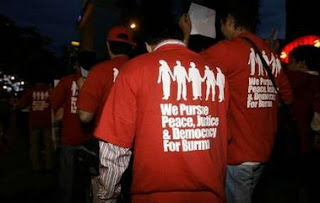
Many held small printed leaflets that read "ASEAN -- Act with Honour, Action on Burma Now".
Three people in front of the group held a large banner that read, "Listen to Burma's Desires, Don't Follow Junta's Order".

Others had written messages on pieces of paper. "Respect Human Rights Now", said one. Another said, "We welcome professor Gambari on behalf of Burmese people."
The United Nations special envoy to Myanmar, Ibrahim Gambari, arrived in Singapore Tuesday expecting to brief leaders of the Association of Southeast Asian Nations (ASEAN), who held their annual summit here Tuesday.
But as Gambari flew to Singapore, the city-state's Prime Minister Lee Hsien Loong, the summit chairman, announced the briefing was cancelled after Myanmar complained the envoy should only report to the Security Council.
Myo Myint Maung, 22, a spokesman for the demonstrators, said they were disappointed by ASEAN's response to the junta.
"We want ASEAN leaders to be more effective and more active regarding their action on Burma," he said. "We are standing here to hold a vigil to protest their statement."
The grouping has come under mounting pressure to rein in its errant member Myanmar after a September crackdown on mass protests, led by Buddhist monks, that left at least 15 people dead and sparked worldwide outrage.
Myo Myint Maung said ASEAN has taken "a very passive stance" towards Myanmar.
It is illegal in Singapore to hold a public gathering of five or more people without a police permit, meaning demonstrations are rare.
Myo Myint Maung said the group did not have a permit for the vigil which occurred a few hundred metres (yards) from the ASEAN summit venue, and just outside a special summit security zone in which even one protester is not permitted.
About 15 minutes after the vigil began, about 20 police converged on the group and asked if they had finished. They said they had, and peacefully dispersed as police recorded some of their names.
Technorati Tags: Singapore, ASEAN, Burma, Student and Protest.
Labels: Asean, Burma, Protest, Singapore, Student
ASEAN Civil Society Conference held in Singapore in Oct
The last IMF / WB meetings saw Singapore and the IFIs blaming each other for hampering protests. This year, we see how Sydney was turned into a police state for APEC. Let's see how this turns out
$$$$$$$$$$$$$$$$$$$$$$$$$$$$$$
Civil Society Organisations (CSOs) in ASEAN now have a platform to represent their views to their governments at the ASEAN Summit.
They can have their say at the ASEAN Civil Society Conference 2007, which will be held in Singapore from October 27-28.
The event has the endorsement of the ASEAN Secretariat.
The Singapore Institute of International Affairs (SIIA), which is organising the event, said the conference will provide the platform for CSOs to convey their views, through ASEAN Secretary-General Ong Keng Yong, to leaders at the 13th ASEAN Summit in Singapore in November.
The conference is expected to focus on human rights, climate change, nuclear safety, fair trade, poverty and development and gender issues.
Associate Professor Simon Tay, Chairman of the SIIA, said: "ASEAN has often been seen as an inter-governmental organisation and (is) sometimes criticised as being limited to the ruling elites.
"We hope this conference, which aims to bring the voice of the people to ASEAN governments, will go some way to bring people and communities into the ASEAN process.
"We hope that the ASEAN Civil Society Conference 2007 will continue to grow into a platform to allow more structured participation by NGOs in ASEAN to work with the ASEAN Secretariat to give feedback to ASEAN heads of governments."
Singapore's Foreign Ministry spokesman said the ASEAN Secretariat will be the approved conduit for CSOs to channel their views to the 13th ASEAN Summit.
Singapore is the current Chair of ASEAN.
Technorati Tags: ASEAN, CivilSocietyOrganisations, CSO and Singapore.
Labels: Asean, Civil Society Organisations, CSO, Singapore
ASEAN Saga for Solidarity Continues
40th Ministerial Meetings in Manila open new horizons for the region More than two weeks after the 40th ASEAN Ministerial Meetings (AMM) concluded, editorial and opinion columns of Philippine newspapers have not ceased assessing its achievements. Manila hosted the high-level ministerial meetings from July 29 to August 2 held at the heavily secured venue of the Philippine International Convention Center (PICC). As has always been observed, such occasion would put the government into a frenzy of "beautification" program weeks before the event. Squatters lining up the shoulder of highways from international airports are relocated, shanties painted with lively colors and idle plots landscaped. In one article, such measures were criticized by housing rights activist groups as being part of a "culture of self-deception."
Yet despite the criticisms, President Gloria Macapagal Arroyo confidently delivered the keynote at the AMM's opening ceremony on July 30 in which she stressed the theme of "one caring and sharing community." In the audience were foreign ministers, special envoys, senior and officials from 26 countries and the European Union. In her speech, President Arroyo highlighted the advances of the ASEAN since its founding in Bangkok in 1967. She defined the vision of an ASEAN community as one that is not only based on economic integration but one anchored on social justice and the alleviation of poverty in the region as well.
While acknowledging the growing complexity of global conditions that could hamper such goals, President Arroyo affirmed ASEAN's important role in the "transformation of (our) region and the world." The need to capitalize on political and geographical relations with East Asia was pointed out as a vital element to the forging of a greater Asian community.
With the target for a full ASEAN Community set for 2015, President Arroyo urged the member states and its dialogue partners to sustain what has so far been achieved in the last 40 years of the organization's existence. The declaration of the ASEAN Charter that was issued during the ASEAN Summit in Cebu City held in January this year was noted as the outcome of the region's desire for integration. Yet given the diversity of Southeast Asia nations and cultures, such integration may not be as smooth as it has been envisioned. In this context, the mention of a Southeast Asian's "shared history" has once again brought on the comparison with the EU's long integration process--difficult but still possible.
The 5-day Manila AMM thus witnessed a strengthened call for unity. Many of the considered highlights of the meetings were also viewed as historic firsts. The denuclearization of the Korean peninsula was given special attention in the Six-Party Talks of foreign ministers and special envoys. In a separate panel, the need to secure the region as a nuclear weapons free zone was addressed in a commission called the Southeast Asia Nuclear Weapons Free Zone Treaty (SEANWFZ) that formulated a 5-year plan of action.
The rights and welfare of migrant workers were also taken up as one of the region's urgent concerns. Two major documents were drawn up to advance and protect the rights and welfare of migrant workers. One of the statements provides for a 'sanctuary' for ASEAN nationals finding themselves in a crisis situation. An ASEAN national living in any ASEAN member state may now seek refuge or assistance in any ASEAN missions. The implication of such a provision for migrant workers, particularly, domestic helpers who are most vulnerable to abuses has been lauded.
However, among the issues taken up in the AMM, the concern for the human rights posed a brief impasse. With the proposal in the ASEAN Charter to include establishing a human rights committee to monitor violations and possibly sanction member countries came the strong objection of Myanmar. Cambodia, Laos, and Vietnam were also noted as having expressed resistance to the human rights committee.
After the deliberations, what was announced however by Foreign Affairs Secretary Alberto Romulo, who chaired most of the meetings, was that a "consensus" has been achieved. Political analysts and commentators, however, were not eager to accept that such a "consensus" could be considered a milestone. The objections of Myanmar and other countries were seen as the result of how nations' individual histories may impede the process of building an ASEAN community.
Noted journalist Amando Doronila of Philippine Inquirer wrote in an editorial http://www.inquirer.net/specialreports/40amm/view.php?db=1&article=20070803-80298 that Foreign Secretary Romulo's declaration that the ministers reached a "consensus" on the human rights committee is shortsighted. The use of the word "consensus," Doronila argues in his article, is simply a semantic vagueness. More than anything else, it is ans evasion of resolution that is often largely described as the ASEAN style of doing things. For Myanmar hence to agree in "principle," may not lead to any strategies that would operationalize the human rights provision.
Adrian E. Cristobal, a veteran journalist of the Manila Bulletin, on the other hand, wrote in his column that "non-interference" in another country's internal affairs, which has been hailed as ASEAN's trademark, may probably be the best deterrent to having a human rights commission for the ASEAN.
With the 5-day meeting officially ending with the ASEAN's chairmanship turned over to Singapore, more is expected to unfold in the November summit. Singapore’s Foreign Minister George Yeo in accepting the new leadership predicts, as quoted an article by Veronica Uy: “The center of gravity of the world shift(ing) to Asia in this century.”
Technorati Tags: ASEAN, Manila, Philippines and Singapore.
Labels: Asean, Manila, Philippines, Singapore
Bush Backs Out of Asean Summit
US ties with Southeast Asia are facing a setback as President George W. Bush cancelled his scheduled first summit with ASEAN leaders and Secretary of State Condoleezza Rice's trip to the region for annual talks seems uncertain.
US officials have informed Singapore, host of the much-touted US-Association of Southeast Asian Nations (ASEAN) summit, that the September 5 date for the talks was now "not convenient," ASEAN diplomats said.
September is critical for Bush as a much-awaited assessment of the situation in insurgency-wracked Iraq would be released that month amid a revolt within his own Republican party over failed war strategy.
"We are actually disappointed," one ASEAN diplomat told AFP.
The landmark summit was aimed at highlighting 30 years of official ties between Washington and ASEAN, which comprises Brunei, Cambodia, Indonesia, Laos, Malaysia, Myanmar, the Philippines, Singapore, Thailand and Vietnam.
On the heels of the failed summit is growing uncertainty about Rice attending an annual ASEAN ministerial meeting, which includes an August 1-2 dialogue between the region and its key trading partners as well as a high-level regional security forum.
The 27-member ASEAN Regional Forum (ARF) is the only high level official security group in the Asia-Pacific region, and includes Russia, India, China and the European Union.
Foreign diplomats say they have heard that Rice may skip the trip to the ASEAN meeting due to a conflict of schedules.
"We will keep you up to date on her travel schedules," State Department spokesman Sean McCormack told reporters Wednesday when asked whether Rice would attend the meeting or send her deputy, John Negroponte.
In 2005, Rice became the first American secretary of state to send her deputy to the ARF since it was first held in 1994, drawing criticism from the region which felt its stature had diminished in Washington's eyes.
Walter Lohman, former senior vice president of the US-ASEAN Business Council, said that based on information he had received, "it looks all but certain that Secretary Rice would take a pass on the ASEAN meetings."
With Bush's cancellation of his summit with ASEAN leaders and Rice's possible non-attendance, Lohman said the immediate future seemed grim for ties between the two sides.
"It is a significant setback in US-ASEAN relations after two good years and the question is, if the administration doesn't quickly get back on track, will there really be enough time in the next 18 months to patch it up," said Lohman, director of the Asian studies center at Washington-based Heritage Foundation.
With 18 months left in the White House for Bush, his administration's Asian diplomacy had been largely focused on trying to end North Korea's nuclear weapons drive in the hope of achieving its true foreign policy victory.
After refusing to engage directly with North Korea, US Assistant Secretary of State for East Asian affairs Christopher Hill decided to make a sudden visit to Pyongyang last month.
In his rush to make the trip, he reneged on an annual meeting with his ASEAN counterparts in Washington.
"Canceling a meeting here or there may not seem like a big deal, but the slights are piling up," Lohman said.
"To anyone watching from Asia, they point past the current position of the United States to a future without it," he said.
ASEAN is the largest US export market after Europe and Japan. The region of more than 500 million people is establishing with China a free trade zone -- which would be the world's biggest.
Technorati Tags: AseanSummit, Bush and Singapore.
Labels: Asean Summit, Bush, Singapore
Development of Democracy in Europe and Asia
If you are in Singapore this Friday the 13th, join the Public Forum on Development of Democracy in Europe and Asia. The forums is held by both the Singapore Democratic Party and the Alliance of Liberals and Democrats from Europe and the Council of Asian Liberals and Democrats (ALDE-CALD) Delegation.
When: 13 Apr 07, Friday, 7:00 pm
Where: Sheraton Towers, Scotts Road
Opal Ballroom
Speakers: Dina Abad
Fiona Hall
Ignasi Cambo Guardans
Eugenijus Gentvilas
Lydie Polfer
Graham Watson
Chee Soon Juan
Technorati Tags: Singapore, SingaporeDemocraticParty, ALDE, CALD and Democracy.
Labels: ALDE-CALD, Democracy, Singapore, Singapore Democratic Party