Myanmar citizens mount protest at ASEAN summit
Remember how Singapore played host to the IMF / WB meetings last year? Protesters were told to protest in a less than accessible area. This time around, that country hosts Association of Southeast Asian Nations (ASEAN) Summit. Burmese students took to the streets peacefully in their bide to free their homeland from the junta. It's a crash course for Human Rights for Singapore.
$$$$$$$$$$$$$$$$$$$$$$$$$$$$$$$$$$$$$$
About 40 Myanmar residents of Singapore held a brief vigil Tuesday night to protest what they said was an inadequate response to the crisis in Myanmar by Southeast Asian leaders meeting here.

It was one of the largest public protests seen in recent memory in Singapore, which has tight rules against demonstrations.
The group of mostly young men and women, all wearing red T-shirts, lined up silently in rows of three on the main Orchard Road shopping and tourist strip.
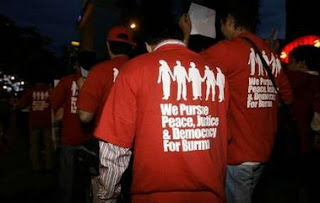
Many held small printed leaflets that read "ASEAN -- Act with Honour, Action on Burma Now".
Three people in front of the group held a large banner that read, "Listen to Burma's Desires, Don't Follow Junta's Order".

Others had written messages on pieces of paper. "Respect Human Rights Now", said one. Another said, "We welcome professor Gambari on behalf of Burmese people."
The United Nations special envoy to Myanmar, Ibrahim Gambari, arrived in Singapore Tuesday expecting to brief leaders of the Association of Southeast Asian Nations (ASEAN), who held their annual summit here Tuesday.
But as Gambari flew to Singapore, the city-state's Prime Minister Lee Hsien Loong, the summit chairman, announced the briefing was cancelled after Myanmar complained the envoy should only report to the Security Council.
Myo Myint Maung, 22, a spokesman for the demonstrators, said they were disappointed by ASEAN's response to the junta.
"We want ASEAN leaders to be more effective and more active regarding their action on Burma," he said. "We are standing here to hold a vigil to protest their statement."
The grouping has come under mounting pressure to rein in its errant member Myanmar after a September crackdown on mass protests, led by Buddhist monks, that left at least 15 people dead and sparked worldwide outrage.
Myo Myint Maung said ASEAN has taken "a very passive stance" towards Myanmar.
It is illegal in Singapore to hold a public gathering of five or more people without a police permit, meaning demonstrations are rare.
Myo Myint Maung said the group did not have a permit for the vigil which occurred a few hundred metres (yards) from the ASEAN summit venue, and just outside a special summit security zone in which even one protester is not permitted.
About 15 minutes after the vigil began, about 20 police converged on the group and asked if they had finished. They said they had, and peacefully dispersed as police recorded some of their names.
Technorati Tags: Singapore, ASEAN, Burma, Student and Protest.
Labels: Asean, Burma, Protest, Singapore, Student
ASEAN Civil Society Conference held in Singapore in Oct
The last IMF / WB meetings saw Singapore and the IFIs blaming each other for hampering protests. This year, we see how Sydney was turned into a police state for APEC. Let's see how this turns out
$$$$$$$$$$$$$$$$$$$$$$$$$$$$$$
Civil Society Organisations (CSOs) in ASEAN now have a platform to represent their views to their governments at the ASEAN Summit.
They can have their say at the ASEAN Civil Society Conference 2007, which will be held in Singapore from October 27-28.
The event has the endorsement of the ASEAN Secretariat.
The Singapore Institute of International Affairs (SIIA), which is organising the event, said the conference will provide the platform for CSOs to convey their views, through ASEAN Secretary-General Ong Keng Yong, to leaders at the 13th ASEAN Summit in Singapore in November.
The conference is expected to focus on human rights, climate change, nuclear safety, fair trade, poverty and development and gender issues.
Associate Professor Simon Tay, Chairman of the SIIA, said: "ASEAN has often been seen as an inter-governmental organisation and (is) sometimes criticised as being limited to the ruling elites.
"We hope this conference, which aims to bring the voice of the people to ASEAN governments, will go some way to bring people and communities into the ASEAN process.
"We hope that the ASEAN Civil Society Conference 2007 will continue to grow into a platform to allow more structured participation by NGOs in ASEAN to work with the ASEAN Secretariat to give feedback to ASEAN heads of governments."
Singapore's Foreign Ministry spokesman said the ASEAN Secretariat will be the approved conduit for CSOs to channel their views to the 13th ASEAN Summit.
Singapore is the current Chair of ASEAN.
Technorati Tags: ASEAN, CivilSocietyOrganisations, CSO and Singapore.
Labels: Asean, Civil Society Organisations, CSO, Singapore
Oppression in Burma Neglected in ASEAN
The whole world has condemned the suppression of peaceful demonstrations in Burma in the past week. The detention of leaders of the 88 Generation Students by the military regime in Rangoon has also been taken up by the United Nations, European Union and the international community. There have been protests before in Burma, mostly small and sporadic since 1988, but this time around the protests were bigger and prolonged. It was a watershed in Burmese politics and could mark the beginning of the end of one of the world's rogue regimes.
The Rangoon regime is used to suppressing its own people without worrying about the consequences. After all, why should they? They have everything under control with their armed security forces and thousands-strong civilian gang - the Union Solidarity and Development Association - whose members are on the streets ready to beat up democracy-loving people and ordinary civilians at a moment's notice. For decades, the Burmese students and people have wanted to express what went wrong in their society. They could not do it. When the paranoid junta leaders decided to move from Rangoon to Naypyidaw in 2005, the Burmese people were shocked.
They knew the junta leaders had spent a fortune to create the Disneyland-like new capital. And to further burden the already tight budget, the junta has grand plans to build a cyber city and, of course, a nuclear plant. But the junta leaders do not have the kind of money they claim to have. Revenues from gas and oil are not expected to come in abundantly until 2010. What else was left but to end fuel subsidies and further squeeze the ordinary people.
So when the junta decided to increase fuel prices, the Burmese people decided they had had enough. Most of the people earn meagre incomes to live from day to day. With the rise in fuel prices, the cost of food and other necessities also shoot skyward. The prices of eggs and garlic have increased by 90 per cent, meat by over 50 per cent. It means the people have to spend at least 90 per cent of their income on food. How can they survive like that? Ending the fuel subsidies will not bring the junta much revenue anyway.
The International Monetary Fund has been advising the junta on how to modernise its economic management and tax collection system. In normal circumstances, the junta's latest move would have been considered sound economic policy. But given the long-standing suppression and suffering of the Burmese people, the fuel-price hike represents a small window to speak out. It could be the straw that broke the camel's back. The students and the public sensed correctly that the time had come to show solidarity on the streets. If there was a lesson learned from the 1988 pro-democracy uprising, it was that one must not look down on the suppressed and hopeless Burmese people because they can rise up. The junta's spell was broken.
As usual, Asean has been dead silent. Senior Asean officials are meeting now in Singapore to finalise the draft of the Asean Charter, a document meant to strengthen the grouping. But it is hypocritical for Asean to talk about making Asean one community or one family. Since its admission in 1997, Asean has had traumatic dealings with Burma. The Burmese regime has never behaved in a way that would enhance a close-knit Asean family. The junta does not care a hoot what Asean thinks. When Thailand had a coup last year, quite a few Asean leaders had strong views on Thai democracy. When it comes to Burma, the leaders are more willing to keep their mouths sealed. It would not be wrong to say that Asean has been always more sympathetic to the Burmese junta. Obviously, a future collapse of the junta would impact on the grouping's democratic space and openness. Asean must have a clear awareness of Burma's situation. The group can no longer sit idle. How can Asean be people-oriented and have a charter that is people-centred if the current suppression of the Burmese people continues without the grouping voicing strong concern?
Technorati Tags: Burma, Junta and ASEAN.
Labels: Asean, Burma, Junta
ASEAN Saga for Solidarity Continues
40th Ministerial Meetings in Manila open new horizons for the region More than two weeks after the 40th ASEAN Ministerial Meetings (AMM) concluded, editorial and opinion columns of Philippine newspapers have not ceased assessing its achievements. Manila hosted the high-level ministerial meetings from July 29 to August 2 held at the heavily secured venue of the Philippine International Convention Center (PICC). As has always been observed, such occasion would put the government into a frenzy of "beautification" program weeks before the event. Squatters lining up the shoulder of highways from international airports are relocated, shanties painted with lively colors and idle plots landscaped. In one article, such measures were criticized by housing rights activist groups as being part of a "culture of self-deception."
Yet despite the criticisms, President Gloria Macapagal Arroyo confidently delivered the keynote at the AMM's opening ceremony on July 30 in which she stressed the theme of "one caring and sharing community." In the audience were foreign ministers, special envoys, senior and officials from 26 countries and the European Union. In her speech, President Arroyo highlighted the advances of the ASEAN since its founding in Bangkok in 1967. She defined the vision of an ASEAN community as one that is not only based on economic integration but one anchored on social justice and the alleviation of poverty in the region as well.
While acknowledging the growing complexity of global conditions that could hamper such goals, President Arroyo affirmed ASEAN's important role in the "transformation of (our) region and the world." The need to capitalize on political and geographical relations with East Asia was pointed out as a vital element to the forging of a greater Asian community.
With the target for a full ASEAN Community set for 2015, President Arroyo urged the member states and its dialogue partners to sustain what has so far been achieved in the last 40 years of the organization's existence. The declaration of the ASEAN Charter that was issued during the ASEAN Summit in Cebu City held in January this year was noted as the outcome of the region's desire for integration. Yet given the diversity of Southeast Asia nations and cultures, such integration may not be as smooth as it has been envisioned. In this context, the mention of a Southeast Asian's "shared history" has once again brought on the comparison with the EU's long integration process--difficult but still possible.
The 5-day Manila AMM thus witnessed a strengthened call for unity. Many of the considered highlights of the meetings were also viewed as historic firsts. The denuclearization of the Korean peninsula was given special attention in the Six-Party Talks of foreign ministers and special envoys. In a separate panel, the need to secure the region as a nuclear weapons free zone was addressed in a commission called the Southeast Asia Nuclear Weapons Free Zone Treaty (SEANWFZ) that formulated a 5-year plan of action.
The rights and welfare of migrant workers were also taken up as one of the region's urgent concerns. Two major documents were drawn up to advance and protect the rights and welfare of migrant workers. One of the statements provides for a 'sanctuary' for ASEAN nationals finding themselves in a crisis situation. An ASEAN national living in any ASEAN member state may now seek refuge or assistance in any ASEAN missions. The implication of such a provision for migrant workers, particularly, domestic helpers who are most vulnerable to abuses has been lauded.
However, among the issues taken up in the AMM, the concern for the human rights posed a brief impasse. With the proposal in the ASEAN Charter to include establishing a human rights committee to monitor violations and possibly sanction member countries came the strong objection of Myanmar. Cambodia, Laos, and Vietnam were also noted as having expressed resistance to the human rights committee.
After the deliberations, what was announced however by Foreign Affairs Secretary Alberto Romulo, who chaired most of the meetings, was that a "consensus" has been achieved. Political analysts and commentators, however, were not eager to accept that such a "consensus" could be considered a milestone. The objections of Myanmar and other countries were seen as the result of how nations' individual histories may impede the process of building an ASEAN community.
Noted journalist Amando Doronila of Philippine Inquirer wrote in an editorial http://www.inquirer.net/specialreports/40amm/view.php?db=1&article=20070803-80298 that Foreign Secretary Romulo's declaration that the ministers reached a "consensus" on the human rights committee is shortsighted. The use of the word "consensus," Doronila argues in his article, is simply a semantic vagueness. More than anything else, it is ans evasion of resolution that is often largely described as the ASEAN style of doing things. For Myanmar hence to agree in "principle," may not lead to any strategies that would operationalize the human rights provision.
Adrian E. Cristobal, a veteran journalist of the Manila Bulletin, on the other hand, wrote in his column that "non-interference" in another country's internal affairs, which has been hailed as ASEAN's trademark, may probably be the best deterrent to having a human rights commission for the ASEAN.
With the 5-day meeting officially ending with the ASEAN's chairmanship turned over to Singapore, more is expected to unfold in the November summit. Singapore’s Foreign Minister George Yeo in accepting the new leadership predicts, as quoted an article by Veronica Uy: “The center of gravity of the world shift(ing) to Asia in this century.”
Technorati Tags: ASEAN, Manila, Philippines and Singapore.
Labels: Asean, Manila, Philippines, Singapore
ASEAN Struggling for Human Rights and Democracy
Reflecting on 40 years of cooperation, it can be said that ASEAN has achieved a great deal. In August 1967, the foreign ministers of five Southeast Asian countries -- Indonesia, Malaysia, Thailand, the Philippines and Singapore -- met in Bangkok and established a new association. At the time, their central concern was to mend fences and to build intra-regional political confidence.
In terms of this basic goal, the accomplishments of ASEAN are clear. Over the last four decades, there has been no direct military confrontation between the five countries. It can be said that the situation today would probably have been significantly different if ASEAN had not existed, taking into consideration the seriousness of intra-regional tensions in the 1960s.
More remarkably, ASEAN has achieved more than its founders originally sought. To begin with, the original five members have integrated all the Southeast Asian countries within the framework of ASEAN, thereby constructing a community of ten nations.
Furthermore, ASEAN has attained a status as the center of Asia-Pacific regional security cooperation, involving major powers such as China, the U.S., Japan and Russia. The association of minor powers in Southeast Asia held the first meeting of the Asian Regional Forum (ARF) in July 1994, thereby taking the initiative for Asia-Pacific region-wide cooperative security. Since then, the ARF has been the most prominent multilateral security arrangement in the Asia-Pacific region.
In addition, in the economic area, ASEAN has quite a track record. The founding document of the association, the 1967 Bangkok Declaration, vaguely stated that ASEAN should accelerate economic growth. Unsurprisingly, during the 1970s and the 1980s, the development of economic cooperation stagnated.
In retrospect, the Singapore Summit in 1992 was the turning point. In this meeting, the leaders decided to seek an ASEAN Free Trade Area (AFTA). Today, it is fair to say that such an area has been virtually established.
The above review of ASEAN cooperation demonstrates that the association has had many achievements. At the same time, however, the challenges which its members are facing today are enormous.
While there are numerous items on the agenda, the most urgent one can easily be singled out: The pursuit of liberalism, the elements of which include the norms of human rights and democracy. The pursuit of liberal agendas has not been an integral part of ASEAN diplomacy, which has traditionally been state-centered, designed to address the interests of governments. The challenge now is to address the interests of the people of Southeast Asia, some of whom have been under political oppression.
The issue of Myanmar constitutes the core of this new challenge. ASEAN has thus far avoided being intrusive. However, the pursuit of liberalism is more urgent than any other agenda item, for two reasons.
The first is a moral one. Although it is not my purpose to make value judgments, it is hard to deny the importance of human rights and democracy. Thus ASEAN should never turn a blind eye to any abuse of human rights in Southeast Asia.
The second reason has to do ASEAN's international standing. Any political actor would lose its international legitimacy if it downplayed the norms of human rights and democracy, which have increasingly attracted concern in today's global society.
ASEAN today has to be accountable to the international community. During the Cold War era, the relevance of the Southeast Asian association was a function of superpower rivalry, and its members focused only on intra-regional fence-mending. In contrast, ASEAN today is an independent player in the global society, involving major powers but itself leading the cooperative security process in the Asia-Pacific region.
If ASEAN is to maintain its status as the center of Asia-Pacific cooperation, it has no choice but to address issues of human rights and democracy. The participant countries of the ARF process do question the legitimacy of the leader of this process. The 2005 ARF is a case in point: The U.S. Secretary of State Condoleezza Rice boycotted the meeting, recognizing the possibility that the Southeast Asian countries might allow Myanmar to chair the series of ASEAN meetings in 2006-2007. In the following year, she attended the ARF, but only because ASEAN had made it clear that Myanmar would not chair the meetings.
The pursuit of liberalism, which is important for these two reasons, is one of the key points at issue in the drafting of the ASEAN Charter. The members of the association are now seeking to establish the charter, and debating whether and to what extent the principle of non-interference in the internal affairs of member states should be modified. The amendment of this principle would enable them to implement intrusive measures and to take punitive action against countries which violated liberal norms.
Yet, at the same time, it would be unreasonable to expect a sudden change in ASEAN's diplomatic style. The unity of the association is crucial for all the members, and any intrusive measure may be detrimental to it. ASEAN has become a global player, only because its members have been able to speak with one voice. Since its establishment, this association of minor powers, by acting as one body, has been able to ensure a bigger role for Southeast Asia than any member could have played alone.
With regard to Myanmar, the ASEAN members have been careful not to alienate this country. The worst scenario for them is that Yangon will become China's proxy, speaking on behalf of Beijing. In this respect, ASEAN needs Myanmar as much as Yangon needs the Southeast Asian association.
The drafting process of the charter has reached its crucial stage. The ASEAN countries are planning to finalize the content of the charter in their summit meeting in November. Their challenge is to strike a balance between two opposing goals -- the enhancement of international legitimacy and the maintenance of the unity of the association.
Technorati Tags: ASEAN, Democracy and HumanRights.
Labels: Asean, Democracy, Human Rights