Myanmar citizens mount protest at ASEAN summit
Remember how Singapore played host to the IMF / WB meetings last year? Protesters were told to protest in a less than accessible area. This time around, that country hosts Association of Southeast Asian Nations (ASEAN) Summit. Burmese students took to the streets peacefully in their bide to free their homeland from the junta. It's a crash course for Human Rights for Singapore.
$$$$$$$$$$$$$$$$$$$$$$$$$$$$$$$$$$$$$$
About 40 Myanmar residents of Singapore held a brief vigil Tuesday night to protest what they said was an inadequate response to the crisis in Myanmar by Southeast Asian leaders meeting here.

It was one of the largest public protests seen in recent memory in Singapore, which has tight rules against demonstrations.
The group of mostly young men and women, all wearing red T-shirts, lined up silently in rows of three on the main Orchard Road shopping and tourist strip.
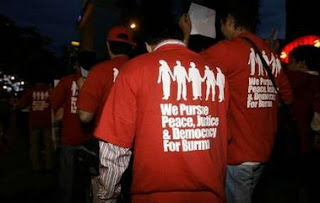
Many held small printed leaflets that read "ASEAN -- Act with Honour, Action on Burma Now".
Three people in front of the group held a large banner that read, "Listen to Burma's Desires, Don't Follow Junta's Order".

Others had written messages on pieces of paper. "Respect Human Rights Now", said one. Another said, "We welcome professor Gambari on behalf of Burmese people."
The United Nations special envoy to Myanmar, Ibrahim Gambari, arrived in Singapore Tuesday expecting to brief leaders of the Association of Southeast Asian Nations (ASEAN), who held their annual summit here Tuesday.
But as Gambari flew to Singapore, the city-state's Prime Minister Lee Hsien Loong, the summit chairman, announced the briefing was cancelled after Myanmar complained the envoy should only report to the Security Council.
Myo Myint Maung, 22, a spokesman for the demonstrators, said they were disappointed by ASEAN's response to the junta.
"We want ASEAN leaders to be more effective and more active regarding their action on Burma," he said. "We are standing here to hold a vigil to protest their statement."
The grouping has come under mounting pressure to rein in its errant member Myanmar after a September crackdown on mass protests, led by Buddhist monks, that left at least 15 people dead and sparked worldwide outrage.
Myo Myint Maung said ASEAN has taken "a very passive stance" towards Myanmar.
It is illegal in Singapore to hold a public gathering of five or more people without a police permit, meaning demonstrations are rare.
Myo Myint Maung said the group did not have a permit for the vigil which occurred a few hundred metres (yards) from the ASEAN summit venue, and just outside a special summit security zone in which even one protester is not permitted.
About 15 minutes after the vigil began, about 20 police converged on the group and asked if they had finished. They said they had, and peacefully dispersed as police recorded some of their names.
Technorati Tags: Singapore, ASEAN, Burma, Student and Protest.
Labels: Asean, Burma, Protest, Singapore, Student
Burmese Protestors vs Junta
PETITION: Support the Burmese protesters here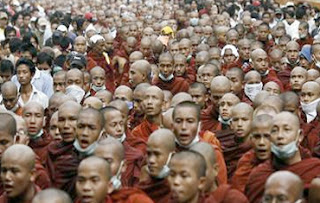
The burgundy robes of Buddhist monks usually evoke a sense of spiritual calm. But for the repressive junta that has ruled Burma for 45 years, the recent sight of shaven-headed clerics marching the streets has been anything but soothing. For more than a week now, tens of thousands of Buddhist clerics have rallied across the country, their daily alms routes turned into paths of protest. Some walked quietly with their begging bowls overturned — an implied excommunication of the military leaders whose punitive fuel hikes provoked the first demonstrations back in August. Initially, Burma's generals tried to extinguish the protests by arresting dozens of pro-democracy activists who had kick started the civil disobedience. But with the Buddhist clergy quickly taking over leadership of the movement, on Wednesday Sept. 26 the regime unleashed a violent crackdown on the protesters — a potentially dangerous move in this deeply devout nation. "The monks are the only ones who really have the trust of the people," says Khin Omar, an exiled dissident now living in Thailand. "When they speak up, people listen."
And when they act, people follow. By Sept. 24, thousands of ordinary Burmese had overcome their fear of the regime and joined the demonstrations, their shoes slapping through the monsoon downpours alongside the monks' bare feet. While marching monks recited prayers in the commercial capital Rangoon, civilians raised their fists and chanted their own mantra: "Democracy, democracy." The participation of normal citizens has turned what had been a series of sporadic rallies into the largest sustained display of dissent in Burma in nearly two decades. "The people's only weapons are their hands," said an elderly teacher watching the procession of protestors with teary eyes. "The government wants to wipe them out, but the people are not afraid."
Could this be the start of a burgundy revolution, another rebellion that upends a long-standing dictatorship? Back in 1988, the Burmese military unleashed a brutal assault on student protestors, leaving thousands dead. This time, the junta at first avoided direct confrontation with the demonstrating monks — after all, this is a country where the 300,000-plus clergy is second in numbers only to the 450,000-strong military. But this is not a regime given to restraint. With the monks' protests showing little sign of abating and civilians joining the movement in large numbers, Burma's top brass reverted to their old ways. On Monday Sept. 24, the nation's Religious Affairs Minister was quoted on state television ordering the monks back to their monasteries. The following morning, trucks mounted with loudspeakers patrolled Rangoon, threatening to arrest anyone who dared join the protesting clerics. The junta then announced a nighttime curfew and said they would enforce an already-present ban on any assembly of more than five people. By Wednesday, riot police and soldiers were stationed around pagodas in Rangoon, and hundreds of marchers had been detained.
Then the violence began, with at least two monks reported killed. As an eyewitness at Rangoon's best-known landmark, the golden Shwedagon Pagoda, tells it, the authorities had locked the famous monument's gates to prevent the monks from gathering. Security forces guarded the entrances. A little after noon, hundreds of monks, students and other Rangoon residents approached the police, sat on the road and began to pray. The troops responded quickly, pulling monks from the crowd and striking both clerics and ordinary citizens with canes. Several smoke bombs exploded, and the riot police charged. Some protestors fought back with sticks and rocks. A car was set alight — by the soldiers, claim the demonstrators — and then the air filled with the unmistakable crack of live ammunition. Soldiers were shooting volleys of bullets into the air. "They are not Buddhists," cried Thurein, a 24-year-old student, clutching half a brick and fleeing from the smoke. "They are not humans. Tell the world. We were praying peacefully and they beat us. They beat the monks, even the old ones." An elderly monk stood with him, bleeding from a baton gash on his shaven head.
The protesters regrouped, though, and surged forward again. Minutes later, a tear-gas canister arced through the air toward the pagoda's eastern entrance. The monks retreated, many still armed with clubs of scavenged wood, one brandishing a riot shield he had snatched from the police. Suddenly, there was an enormous explosion: a clap of thunder. The demonstrators applauded this sign of cosmic solidarity. One monk raised his hands to the heavens, shouting "The rain is coming! The soldiers will be struck by lightning!" Nearby, a woman responded, "Lightning is not enough. They deserve more." A cheer went up with each subsequent clap of thunder.
Eventually, the battle stopped. The clerics gathered at a nearby monastery to march downtown. But first came a chilling display of the people's anger — and the monks' moral influence. A man on a motorcycle rode up. Most motorcycles have been banned for years because, the story goes, the paranoid generals feared being shot by an assassin riding one of them. Those few people who can tool around on motorcycles are therefore assumed to be government spies. The mob pounced on the man, pulling him off his bike and raising their wooden sticks. "Beat him," they cried. "Kill him." Quickly, the monks intervened and hustled the man to the safety of a monastery. The crowd was forced to take out their ire on the motorbike, smashing it to bits with clubs and rocks. "If the monks had not saved him," said a Burmese cameraman filming the scene, "he would be dead for sure." In 1988, some lynchings of government agents were stopped by monks and students; far more were not.
Despite the clash at Shwedagon, the monks continued on, their fervor broadcast over loudspeakers: "Let us overthrow the government." By early afternoon, the demonstrators had marched the two miles to the Sule Pagoda, another holy site. Again, the path to the pagoda itself was blocked by hundreds of security forces, many with bayonets fixed. The protestors sat and prayed in front of them. More soldiers armed with rifles arrived, though, and most of the crowd stood up and walked away. Twenty minutes later, the troops opened fire — a 10-second burst above the heads of those marchers who had dared to stay. People fled, but not for long. Another column of ralliers, at least a mile long, wound through the streets to join them. But as dusk approached, the crowds dispersed again. Shops in the Sule area had been shuttered all afternoon. In a city where the streets are vibrant and bustling until late, most residents had taken refuge at home. No one wanted to be out after dark.
Other nations, most of whom greeted the '88 crackdown with silence, are keeping a much closer watch this time on the unfolding drama in Burma. On Wednesday, the U.N. Security Council convened an emergency meeting to discuss the turmoil in the country. A day before in his address to the U.N General Assembly in New York City, U.S. President George W. Bush criticized the "reign of fear" in Burma; he unveiled further restrictions on the regime, including travel bans to the U.S. for members of the junta and their families, extending sanctions that have been in place for a decade. The same day, Britain's Foreign Secretary David Miliband spoke of how "brilliant" it was to see monks march on Saturday to the home of Nobel Peace Prize laureate Aung San Suu Kyi, the daughter of the independence hero who led Burma's struggle against the British. Suu Kyi has spent much of the past 18 years under house arrest. Her National League for Democracy (NLD) won elections back in 1990, but the generals refused to honor the results. "It will be a hundred times better," said Miliband, "when she takes her rightful place as the elected leader of a free and democratic Burma."
That sentiment echoes the wishes of many in the Buddhist clergy, who through the newly formed All-Burma Monks Alliance, have called for Suu Kyi's release and, even more dramatically, the junta's expulsion "from Burmese soil forever." "We must not retreat," vows a 23-year-old monk in Rangoon. "If we retreat, we fail." Historically, Buddhist clerics have been a key element of resistance in Burma, from British colonial days through the democracy rallies in 1988. But this time, the monks are not simply adding their moral authority to the movement; they are leading the protests. The shift is significant, particularly for a junta that has tried to burnish its influence by linking itself to Buddhism. Burma's government-run newspapers regularly display generals lavishing money on building new pagodas and monasteries. "The junta has bent over backwards to show how good Buddhists they are," says Josef Silverstein, a Burma expert at Rutgers University in New Jersey. "For them to legitimize a crackdown, they will have to prove that the protests are being led by misguided monks who are actually misusing Buddhism."
Burma's generals will have a tough time convincing the public they hold more spiritual suasion than the monks. Holed up in Naypyidaw, a city that was constructed out of jungle in 2005 to replace Rangoon as the national capital, the military leaders have virtually barricaded themselves from their subjects. While ordinary Burmese get ever poorer because of the junta's economic mismanagement, the generals live in swanky mansions and drive fancy cars. The government has signed lucrative gas-pipeline and timber deals with other nations, but little of the money trickles down to ordinary people. The steep fuel hikes in August only heightened the economic disparity, as some formerly white-collar workers could no longer afford to take the bus to the office. Buddhist clerics are experiencing privation, too, since their lives depend on offerings from the people. "The monks are an economic barometer in Burma," says Sunai Phasuk, a consultant for Human Rights Watch in Bangkok. "They feel the deterioration of the economy and the hardship of their followers."
The ruling class' isolation stands in contrast to the increased connectivity of the Burmese people. Technology has revolutionized dissent. Cell phones can now be rented for $50 a month, and a click of a button sends pictures of protests to the outside world. Aung Zaw, an exiled student activist who edits the Irrawaddy, a Thailand-based publication that covers Burmese affairs, recalls how it took nearly a month for word of student protests in the early 1990s to reach Thailand. "Now we get information about protests almost instantly," he says, "and it's then sent back to people in Burma so they know what's going on across the country." The flow of information has even spawned a group of Burmese bloggers, some of whom operate out of Rangoon's 200-plus Internet cafés. (Just four years ago, there were fewer than 30 such Web cafés.) On Sept. 1, as protests against the fuel hikes were gathering momentum, 600 people showed up at the inaugural meeting of the Myanmar Bloggers Society in Rangoon. One member, a computer instructor who later witnessed Suu Kyi's Saturday meeting with the monks, uploaded a grainy digital photo she took of the momentous event. A few hours later, the picture had traveled across the globe.
Such powerful images may hearten democracy advocates worldwide, but will they persuade Burma's soldiers to disobey orders to shoot directly at the protesters? For all its economic incompetence, Burma's junta has managed to hold together the military remarkably well. Most high-level government positions are held by army officers, and lowly grunts can work their way up the ranks. Junta leader General Than Shwe, for instance, started off as a rank-and-file soldier whose psychological-warfare expertise and loyalty to predecessor Ne Win won him promotions. Still, there may be some cracks in the military's façade. "Than Shwe or senior military leaders might not care about international opinion or the feelings of the people, but some middle- and lower-ranking officers surely do," says Win Min, a Burmese military analyst based in northern Thailand. "These younger officers don't want to be hated by the people for the next 30 years."
Key to the equation may be China, Burma's largest trading partner and ideological ally. But despite calls from the West for China to use economic leverage over Burma, it's not clear how much influence Beijing really has. "China will urge Myanmar to use peaceful means to solve the problem, [because] China would like to see a stable environment in Myanmar," says Zhai Kun, an expert on Southeast Asia at the China Institutes of Contemporary International Relations in Beijing. "But because Myanmar is a closed society, I don't think they listen to advice from the outside, including China."
That puts all the more pressure on Burma's monks, as the only force whose authority can challenge that of the military. Monks have urged the generals to avoid bloodshed by sitting down for reconciliation talks with Suu Kyi's NLD. The hope is that dialogue might lead to a power-sharing agreement that recognizes the 1990 election results. So far, the junta has pointedly ignored the 62-year-old democracy activist. Indeed, recently passed constitutional guidelines bar Suu Kyi from holding power because she lacks military experience and was married to a foreigner. But Suu Kyi clearly has the vote of some in the Buddhist clergy, as evidenced by their symbolic visit to her house. "Even if they are not political, the monks hear stories about the daily struggles of the Burmese people and the repression of the junta," says Aung Naing Oo, a Burmese political analyst based in Thailand. "They feel their pain, and they cannot just sit back idly." The NLD, even with its ranks ravaged by imprisonment and exile, may be the only political alternative Burma has — and many monks know it.
Of course, no amount of Buddhist mantras chanted in Suu Kyi's name are likely to convince Burma's generals to give up power quietly. They have ruled with an iron grip, and with impunity, for nearly half a century, and have already brutally crushed one major democracy movement. With the clashes on Sept. 26, the regime once again displayed its capacity for violence. Burma's burgundy revolutionaries can only pray that their robes will not be stained further — by the color of blood.
Technorati Tags: Burma, Myanmar, Junta, Military and Protest.
Labels: Burma, Junta, Military, Myanmar, Protest
Bush Slams Burma
Bush attends APEC in Sydney, obviously all of us would want to take to the streets and be heard. John Howard implements all sorts of "security equipment" tall fences, water canon and even a ban list.
Now Bush goes to Sydney and slams Burma for their crackdown on protest marches. The sheer irony.
$$$$$$$$$$$$$$$$$$$$$$$$$$
US PRESIDENT George Bush has slammed Burma's military regime, promising to use the APEC conference to speak out against a crackdown on protest marches.
"It's inexcusable that we've got this kind of tyrannical behaviour in Asia," Mr Bush said at a press conference with Prime Minister John Howard.
Small bands of Burmese took to the streets of the capital, Rangoon, to protest at a Government hike in petrol prices. In some cases, the cost of fuel soared by five times. In response, regime-sponsored gangs beat protest leaders. So far, the military has stayed in its barracks.
The Burmese junta is sensitive to organised protests, fearing they could become a campaign for political change.
Protests in 1988 opened the way for elections two years later, won by the National League for Democracy, the party led by Nobel peace prizewinner Aung San Suu Kyi. The military refused to accept the result, keeping Ms Suu Kyi under house arrest for much of the time since.
Mr Bush yesterday said people in free societies needed to speak out against human rights abuses.
Australia has a ban on military exports to Burma and visits by senior regime figures. Last week, Labor's foreign affairs spokesman, Robert McClelland, called on the Government to condemn the latest crackdown.
Technorati Tags: APEC, GeorgeBush, Burma, JohnHoward and Protest.
Labels: APEC, Burma, George Bush, John Howard, Protest
Oppression in Burma Neglected in ASEAN
The whole world has condemned the suppression of peaceful demonstrations in Burma in the past week. The detention of leaders of the 88 Generation Students by the military regime in Rangoon has also been taken up by the United Nations, European Union and the international community. There have been protests before in Burma, mostly small and sporadic since 1988, but this time around the protests were bigger and prolonged. It was a watershed in Burmese politics and could mark the beginning of the end of one of the world's rogue regimes.
The Rangoon regime is used to suppressing its own people without worrying about the consequences. After all, why should they? They have everything under control with their armed security forces and thousands-strong civilian gang - the Union Solidarity and Development Association - whose members are on the streets ready to beat up democracy-loving people and ordinary civilians at a moment's notice. For decades, the Burmese students and people have wanted to express what went wrong in their society. They could not do it. When the paranoid junta leaders decided to move from Rangoon to Naypyidaw in 2005, the Burmese people were shocked.
They knew the junta leaders had spent a fortune to create the Disneyland-like new capital. And to further burden the already tight budget, the junta has grand plans to build a cyber city and, of course, a nuclear plant. But the junta leaders do not have the kind of money they claim to have. Revenues from gas and oil are not expected to come in abundantly until 2010. What else was left but to end fuel subsidies and further squeeze the ordinary people.
So when the junta decided to increase fuel prices, the Burmese people decided they had had enough. Most of the people earn meagre incomes to live from day to day. With the rise in fuel prices, the cost of food and other necessities also shoot skyward. The prices of eggs and garlic have increased by 90 per cent, meat by over 50 per cent. It means the people have to spend at least 90 per cent of their income on food. How can they survive like that? Ending the fuel subsidies will not bring the junta much revenue anyway.
The International Monetary Fund has been advising the junta on how to modernise its economic management and tax collection system. In normal circumstances, the junta's latest move would have been considered sound economic policy. But given the long-standing suppression and suffering of the Burmese people, the fuel-price hike represents a small window to speak out. It could be the straw that broke the camel's back. The students and the public sensed correctly that the time had come to show solidarity on the streets. If there was a lesson learned from the 1988 pro-democracy uprising, it was that one must not look down on the suppressed and hopeless Burmese people because they can rise up. The junta's spell was broken.
As usual, Asean has been dead silent. Senior Asean officials are meeting now in Singapore to finalise the draft of the Asean Charter, a document meant to strengthen the grouping. But it is hypocritical for Asean to talk about making Asean one community or one family. Since its admission in 1997, Asean has had traumatic dealings with Burma. The Burmese regime has never behaved in a way that would enhance a close-knit Asean family. The junta does not care a hoot what Asean thinks. When Thailand had a coup last year, quite a few Asean leaders had strong views on Thai democracy. When it comes to Burma, the leaders are more willing to keep their mouths sealed. It would not be wrong to say that Asean has been always more sympathetic to the Burmese junta. Obviously, a future collapse of the junta would impact on the grouping's democratic space and openness. Asean must have a clear awareness of Burma's situation. The group can no longer sit idle. How can Asean be people-oriented and have a charter that is people-centred if the current suppression of the Burmese people continues without the grouping voicing strong concern?
Technorati Tags: Burma, Junta and ASEAN.
Labels: Asean, Burma, Junta