Wolfowitz Quits
A very accurate article, Wolfowitz simplified. Good riddance.
!@#$!@#$!@#$!#@$!@#$!@#$!@#$
Paul Wolfowitz, master mind of the Iraq War, left his post as U.S. Deputy Defense Secretary, after he got the destruction of Iraq that he and his Ziocon conspirators wanted. Bush then handed him the job of president of the World Bank where he and others thought he would advance the bank's debt and exploitation of the third world. But a man who cannot control his own sex urges cannot be expected manage the coffers of the Global Corporate Empire. His "resignation" and the chaotic struggle within the World Bank comes as one more piece of evidence that the empire is in crisis.
The hatred his World Bank colleagues quickly developed for him turned into an internicine, capitalist battle that left Wolfowitz vulnerable. When he was first trapped with his corruption, he pouted, a pathetic sullen figure - complaining that a "smear campaign" was being executed against him. Then he turned rabid against his colleagues at the World Bank, "If they fuck with me or Shaha, I have enough on them to fuck them too." Finally, today, he was cornered and this Bush-backed rat caved in and resigned. Bush was quoted in the news today saying, "I'm sorry it turned out this way".
Tonight, U.S. Treasury Secretary Henry Paulson attempted to defend him on the PBS Jim Lehrer show. A stumbling, fumbling Paulson side-stepped every question asked him by Jim Lehrer, knowing full-well that Wolfowitz stood naked and without a credible defense. In a last desperate attempt to salvage something-Wolfowitz, Paulson told Lehrer that Wolfowitz "planted seeds" in Africa that will bear fruit in the future, attempting to depict him as a humanitarian. If Paul Wolfowitz planted any seeds in Africa during his brief tenure, they will only produce more enslaving third-world debt for which the Bank is now well-known.
In his career death-throes, Wolfowitz used the U.S. government to leverage a few face-saving words on his behalf and no doubt he will leave with money in his pocket. But Paul Wolfowitz will always be known for the millions of lives he has destroyed in Iraq and the destruction he has wrought in the Middle East and throughout the world. He thought his escape from the Iraqi War was clean, leaving the failure in the lap of George Walker Bush. But oh how the mighty are fallen. We share the knowledge with millions of others that the natural order of things and the new world revolution has brought down this enemy of the people. But the real reason Wolfowitz was canned is much deeper than his tawdry sex life. One has to look at the corruption and international exploitation of the World Bank to understand.
Technorati Tags: WorldBank, Wolfowitz and Quits.
Labels: Paul Wolfowitz, Quits, World Bank
Democrats Urge Bush to End World Bank Crisis
Senior U.S. Democrats urged President George W. Bush to step in to end the "historic crisis" over Paul Wolfowitz's World Bank leadership as pressure mounted for him to resign to avoid a possible divisive vote.
The World Bank's 24-nation board of member countries is set to meet on Friday to decide Wolfowitz's fate over a controversial pay and promotion deal that he approved in 2005 for his companion, bank Middle East expert Shaha Riza.
The board is divided. European countries are pushing for Wolfowitz to step down and the United States is shoring up support for him among a clutch of allies like Canada and a few Asian and African countries.
In a letter to Bush, Senate Majority Leader Harry Reid and Democratic Sens. Patty Murray, Richard Durbin and Charles Schumer warned that the crisis was damaging the institution and undermining U.S. interests, especially its traditional role in choosing the bank's president.
"We urge you to take decisive action quickly to bring this crisis to a close," they told Bush, echoing concerns expressed by other prominent Democrats, including presidential candidates Bill Richardson and John Edwards.
The Democratic senators said the bank's board may be compelled to take an unprecedented step and vote on Wolfowitz's fate.
There are no rules for the dismissal of a World Bank chief because it has never happened in the bank's 62-year history and could either be put to a vote or decided by consensus.
"We do not believe the bank's mission or U.S. interests would be advanced by such a vote," the senators wrote.
They questioned the manner in which the crisis had been handled and in part blamed Wolfowitz, who has always been controversial because of his leading role in the Iraq war.
"The current situation is complex and unfortunately may be fueled in part by views toward Mr Wolfowitz unrelated to his tenure at the bank," the senators said.
"At the same time, it is likely that, at least by adding to confusion about the facts, Mr Wolfowitz played a role in aggravating the crisis."
The furore has paralysed the World Bank for more than a month since leaked documents emerged over Wolfowitz's handling of Riza's high-paying promotion. That unleashed widespread anger among bank staff and prompted an inquiry.
The bank's employee association said the institution's credibility depended on how the crisis was resolved.
The White House, which had previously deferred questions over the Wolfowitz matter to the U.S. Treasury, insisted on Wednesday it was not "hanging Paul Wolfowitz out to dry" and that he had the Bush administration's strong support.
"We still support him fully," White House spokesman Tony Snow told reporters on board Air Force One as he flew with Bush to visit parts of Kansas devastated by tornadoes last week.
The Treasury is officially responsible for U.S. World Bank policy, but Wolfowitz is strongly identified with the White House as an architect of the American-led invasion of Iraq.
Both the White House and the Treasury have urged that Wolfowitz be given time to properly explain his actions.
Wolfowitz had until the close of business Wednesday to respond to findings in a 600-page report by a bank panel that concluded his conduct over the promotion broke rules and represented a conflict of interest.
Meanwhile, Germany, which heads the World Bank board, said it had called for Wolfowitz to step down.
Karin Kortmann, a state secretary for German development ministry, said Minister Heidemarie Wiezorek-Zeul told Wolfowitz during meetings of the World Bank in April she was worried about the bank and urged him to quit.
"She made it clear to (Wolfowitz) that his voluntary resignation was the best solution for the bank and its goals," Kortmann told lawmakers in the German parliament.
Kortmann said Germany was not looking for a confrontation with the United States and that pushing through any solution against Washington's wishes would be difficult.
"The United States should rather be given room to react to the current leadership crisis in the bank," Kortmann added.
Technorati Tags: Democrats, Bush, WorldBank and Wolfowitz.
Labels: Bush, Democrats, Paul Wolfowitz, World Bank
The Real Scandal At The World Bank
The Real Scandal At The World Bank
The Bank is Killing Thousands of the Poorest People in The Worldby Johann Hari
While the world’s press has been fixated on the teeny-weeny scandal over whether the World Bank president Paul Wolfowitz helped to get his girlfriend a $300,000-a-year gig next door, they have been ignoring the rancid stench of a far bigger scandal wafting from Wolfie’s Washington offices.
This slo-mo scandal isn’t about apparent petty corruption in DC. It’s about how Wolfowitz’s World Bank is killing thousands of the poorest people in the world, and knowingly worsening our worst crisis - global warming - every day.
Let’s start with the victims. Meet Hawa Amadu, 70-something, living in the muddy slums of Accra, the capital of Ghana, and trying to raise her grandkids as best she can. Hawa has a problem - a massive problem - and the World Bank put it there.
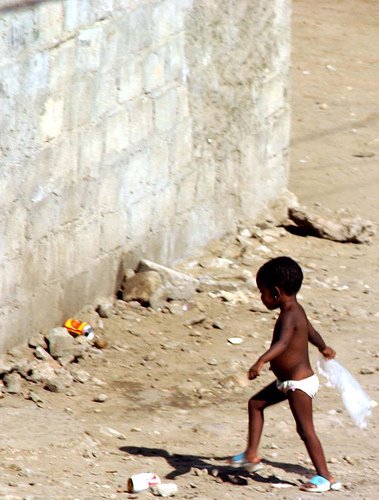
She can’t afford water or electricity any more. Why? The World Bank threatened to refuse to lend any more money to her government, which would effectively make it a leper to governmental donors and international business, unless it stopped subsidising the cost of these necessities. The subsidies stopped. The cost doubled. Now Hawa goes thirsty so her grandchildren can drink, and weeps: “Am I supposed to drink air?”She is not alone. Half a world away, in Bolivia, Maxima Cari - a mother - is also thirsty. “The World Bank took away my right to clean water,” she explains. In 1997 the World Bank demanded the Bolivian government privatise the country’s water supply. So Maxima couldn’t afford it any more. Now she has to use dirty water from a well her villagers dug. This dirty water is making her children sick, and she is sullen. “I wash my children weekly,” Maxima says. “Sometimes there’s only enough water to wash their hands and faces, not their whole body … This is not a nice way to live.” The newly elected socialist government of Evo Morales is planning to take the water back - and he is, of course, condemned and threatened by the World Bank.
Meet some more victims. I have met hundreds, from Africa to Latin America to the Middle East. Muracin Claircin is a rice farmer in Haiti - only he can’t grow rice any more. In 1995, the World Bank demanded Haiti drop all restrictions on imports. The country was immediately flooded with rice from the US, which has been lavishly subsidised by the US government. The Haitian government barely exists and can’t offer rival subsidies anyway: the World Bank forbids it. So now Muracin is jobless and his family are starving.
Some 5,000 miles away, Charles Avaala in Ghana is watching his tomatoes rot. He used to grow them for a government-owned community tomato cannery that provided employment for his entire community. The World Bank ordered his government to close it down, and to open the country’s markets to international competition. Now he can’t compete with the subsidy-fattened tomatoes from Europe. He, too, is starving.
How would Hawa and Maxima and Muracin and Charles feel if you told them none of this is considered a scandal, but business as usual?
These victims are not merely an anecdote soup; they are an accurate summary of the World Bank’s effect on the poor. Don’t take my word for it. The World Bank’s own Independent Evaluation Group just found that barely one in ten of its borrowers experienced persistent growth between 1995 and 2005 - a much smaller proportion than those who stagnated or slid deeper into poverty. The bank’s own former chief economist, Nobel Prize-winner Joseph Stiglitz, says this approach “has condemned people to death… They don’t care if people live or die.”
Why? Why would a body that claims to help the poor actually thrash them? Because its mission to end poverty has always been mythical. As George Monbiot explains in his book The Age of Consent, the World Bank was created in the 1940s by US economist Henry Dexter White to be a further projection of US power. The bank’s head is invariably American, the bank is based in Washington, and the US has a permanent veto on policies. It does not promote a sensible mix of markets and state action - the real path to development. No: the World Bank pursues the interests of US corporations over the poor, every time.
The bank’s staff salve their consciences by pickling themselves in an ideology - neoliberalism - that says there is never a conflict between business rights and human rights. If it’s good for Shell, it must be good for poor people - right?
This ideology also backfires on us in the rich world. In 2000, the World Bank was finally forced to undertake a review of its energy policies. It did its best to rig it, putting the former energy minister of the corporation-licking Indonesian dictator General Suharto in charge. Emil Salim was even serving on the board of a coal company at the time he was appointed. But - to everyone’s astonishment - Salim concluded by opposing the carbon-pumping oil and gas projects that make up 94 per cent of all the bank’s energy projects. He said they should be stopped altogether by 2008.
The bank’s response? It ignored its own report and carried on warming. The business climate, it seems, trumps the actual climate. Feel the heat.
While the elites huff and puff about Wolfowitz’s alleged small corruption and ignore his organisation’s proven immense corruption, there is something we - ordinary citizens - can do. In the summer of 2001, at the global justice protests in Genoa, I met Dennis Brutus, a former inmate of Robben Island prison alongside Nelson Mandela. He had been repelled by the bank’s actions in South Africa, and started his protests against them by asking a very basic question: who owns the World Bank? It turns out we do. Ordinary people in the West - through their trade unions, churches, town councils, universities and private investments - own it. The bank raises nearly all its funds by issuing bonds on the private market. They are often held by socially minded institutions, the kind who signed up to Make Poverty History. So, Brutus realised, we have a simple power: to sell the bonds and bankrupt the World Bank. “We need to break the power of the World Bank over developing countries just as the disinvestment movement helped break the power of the apartheid regime in South Africa,” he explained.
The campaign to make World Bank bonds as untouchable as apartheid-era investments has already begun. The cities of San Francisco, Boulder, Oakland and Berkeley have sold theirs. Several US unions have also joined. Even this small ripple has caused anxiety within the bank about the threat to its “AAA” bond rating.
In the Genoa sun, as tear gas fired by the Italian police hissed in the background, Brutus told me: “I lived to see the death of political apartheid. Now I want to live to see the end of global financial apartheid.”
This is the fight we should join. Not some petty squabble over which Washington technocrat is morally pure enough to lead the forces of subsidy-slashing and starvation.Technorati Tags: WorldBank, PaulWolfowitz and .
Labels: Global Warming, Paul Wolfowitz, World Bank
Wolfowitz Struggles to remain as WB President
Petition to sack Wolfowitz here! Paul D. Wolfowitz’s struggle to remain as president of the World Bank was dealt a setback on Sunday when a group of two dozen of the world’s finance ministers and leaders of other international organizations delivered an unusually public rebuke of his leadership, expressing “great concern” about the institution’s future and the need to preserve its credibility and the morale of its staff.
Mr. Wolfowitz, responding at a news conference, vowed to stay on at the bank, however, saying that he too cared about the bank’s ethical standards. “Look, I believe in the mission of this organization, and I believe I can carry it out,” he said.
The extraordinary exchange between Mr. Wolfowitz and the ministers and officials on a global committee that oversees both the bank and the International Monetary Fund, deepened the uncertainty over Mr. Wolfowitz’s future, which was thrown into doubt by the disclosure that he played a direct role in granting a pay raise and promotion to a female companion when she was transferred in 2005.
The events of the day, in which top officials took time out from discussing issues like poverty, set up a clear impasse between Mr. Wolfowitz and the leadership of the bank, as represented by what seemed to be most of the world’s finance ministers and most of the members of a separate 24-member executive board that governs its day-to-day affairs.
The rebuke of Mr. Wolfowitz came in the form of bureaucratic language in a series of sentences in the board’s communiqué that asserted “the current situation is of great concern to all of us,” an unusually blunt statement for a circumspect institution.
“We have to ensure that the bank can effectively carry out its mandate and maintain its credibility and reputation as well as the motivation of its staff,” the committee said. “We expect the bank to adhere to a high standard of internal governance.”
Though the language was indirect, the message it sent was unmistakable, according to officials who have been meeting in Washington the last few days. “Words like ‘concerned,’ ‘credibility’ and ‘reputation’ are pretty unprecedented for a communiqué from a place like the World Bank,” said an official involved in the drafting of the statement.
At issue in these statements was a crisis arising from
Mr. Wolfowitz’s involvement in decisions to transfer his companion, Shaha Ali Riza, to a new job and give her a raise.
Officially, Mr. Wolfowitz and the bank are now to wait for a full report by the bank’s board on his leadership and charges of favoritism in dealing with Ms. Riza, who was employed at the bank until 2005. But bank officials said that in delaying a finding on the matter, the board seemed to be buying time for Mr. Wolfowitz to consider resigning.European officials close to the bank said that if anything, Mr. Wolfowitz’s apparent dismissal of the criticism on Sunday would increase the determination of the wealthy European donor nations of the bank especially Britain, France and Germany that he needed to step aside for the good of the bank.
Several European officials said their concern now was that Mr. Wolfowitz would not be able to carry out the job of raising $30 billion over the next three years for the International Development Agency, the arm of the bank that provides low-cost loans and assistance to the world’s poorest countries.
Mr. Wolfowitz signaled that raising the $30 billion was already a major challenge over the last year, not because of recent events. “The donors are now unfortunately in a position of not fulfilling their promises,” he said. Concerns about the future of this money were conveyed during the weekend to Treasury Secretary Henry M. Paulson Jr., European officials said.
“This was a point conveyed in several meetings,” said a bank official. “I think Paulson knows this.”
Late Sunday, a Treasury spokeswoman, Brookly McLaughlin, said Mr. Paulson “is counseling all parties to allow the process to proceed in a fair and respectful manner.”
Mr. Wolfowitz’s comments came after a top steering committee of the bank and the International Monetary Fund declared that “the current situation is of great concern to all of us.”
“We have to ensure that the bank can effectively carry out its mandate and maintain its credibility and reputation as well as the motivation of its staff,” the committee said. “We expect the bank to adhere to a high standard of internal governance.”
Bank officials and others close to the executive board said they hoped that Mr. Paulson, who they said mostly listened to complaints about Mr. Wolfowitz over the past three days and counseled patience on his future, would play a crucial role in persuading him to step down eventually.
A senior European official in the meetings said this was possible because Mr. Paulson went along with a communiqué that criticized Mr. Wolfowitz.
By all accounts, Mr. Wolfowitz spent the weekend churning through meetings with a determination to project confidence that he could weather the crisis.
“I think he has just wanted to tough it out,” said a bank official who watched him. “He’s clearly hoping that once everyone leaves town, he can go on and that all this will fade away. That has not happened and it is not going to happen.”
Mr. Wolfowitz made his public comments about intending to stay on at a news conference with Rodrigo de Rato, the head of the International Monetary Fund, and the chairman of the steering committee, Agustín Carstens, the finance minister of Mexico.
Each time he tried to steer the discussion into the importance of eradicating poverty in Africa and elsewhere, he was brought back to questions about whether he could lead an institution that, fairly or not, was in virtual revolt against him.In response, Mr. Wolfowitz said that he agreed with the communique’s conclusion that the integrity of the bank was important and that he, like the bank’s policy supervisors, would await the conclusions of the bank board.
“The board is looking into the matter, and we’ll let them complete their work,” he said with a pained smile.
An earlier indication of Mr. Wolfowitz’s defiant approach came Saturday night, when he sent an e-mail message to World Bank employees with a link to selected documents that came to light on Friday relating to his handling of the case of Ms. Riza.
The documents he referred to showed that Mr. Wolfowitz had wanted to remove himself from handling Ms. Riza’s transfer and raise but was forced to make the arrangements himself because top lawyers and ethics officials at the bank said they did not want to get involved.
The e-mail seemed to increase the anger on the bank board and staff. A top official involved in the board meetings, which occurred on and off throughout the weekend, said, “It has backfired.”
That was also the view of others who more bluntly have called for Mr. Wolfowitz’s dismissal.
“We have not heard anything that will change our minds,” said April Cave, chairwoman of the association that represents most of the bank’s 7,000 employees in Washington. “He has apologized, but he hasn’t shown how he can restore trust at the bank.”
Some bank officials said that as a practical matter, Mr. Wolfowitz’s future may be decided by a complicated interplay of Bush administration and European politics.
The antipathy to his leadership is especially high in Britain, France and Germany, they said. The British chancellor of the exchequer, Gordon Brown, who is expected to succeed Tony Blair as prime minister as early as this summer, is under pressure from his own political base to stand up to the United States more than Mr. Blair has.
Technorati Tags: WorldBank and PaulWolfowitz.
Labels: Paul Wolfowitz, World Bank